The Summer Book, Tove Jansson’s novel about love, family and nature, will make you nostalgic f
by The Conversation
The Summer Book, Tove Jansson’s novel about love, family and nature, will make you nostalgic for your own childhood
A short novel of rare beauty, Tove Jansson’s The Summer Book (1972) tells the story of Sophia, a six-year-old girl spending the summer with her grandmother on a remote island in the Gulf of Finland.
Jansson is best known for the Moomins, the small hippo-like creatures she started drawing in her youth, and which later made her famous around the world. But she was also a remarkably prolific artist, who explored satirical illustration, painting, children’s literature and novels.
Jansson’s Moomins are much-loved children’s characters. Olga Popova / Shutterstock
Finnish-born and Swedish-speaking, her writing sits comfortably within two major traditions of Scandinavian literature: one of imaginative children’s writers, from Hans Christian Andersen to Astrid Lindgren, and the other of fierce women writers that included Karen Blixen (of Out of Africa fame) and Selma Lagerlöf, who won the Nobel Prize for Literature in 1909.
She published satirical cartoons in various newspapers, and eventually her first Moomins story, The Moomins and the Great Flood, in 1945. If dreaming up Moomin adventures helped her during and after the war, writing The Summer Book helped work through the grief of losing her mother on whom the grandmother character is based.
The little girl is based on Jansson’s niece, Sophia, and the girl’s father on her brother, Lasse. The house on the island was inspired by the Jansson family summer house on a little rocky outcrop called Klovharun.
Making the everyday magic again
There is no better time than the end of summer to read this book. It will remind you of your own childhood summers, of that languid feeling of being a little bored and coming up with improbable games and pondering unanswerable questions like, “Are there ants in heaven?” or learning why you should never step on moss.
While it came partly from a place of grief and darkness, The Summer Book is an incredibly luminous book, a dynamic that is mirrored in Grandmother’s inevitable physical decline and Sophia’s buoyant growth. The descriptions are so vivid that you can almost smell the salty, cold beaches, picture the sunburned freckly noses and long for the endlessly bright evenings.
Most of all, it is a book about love and the importance of family bonds. The delicate relationship between Sophia and her grandmother is one of the most truthful descriptions of inter-generational relationships ever written. Very few authors are able to capture the depth of a child’s emotional world as well as Tove Jansson. The Summer Book is never sentimental and yet it is filled with love, wisdom and humour.
Nothing really happens and yet everything does. Every small adventure, from learning to gain the love of a shifty cat, to trying to plant new flowers on the island, becomes a metaphor for life itself.
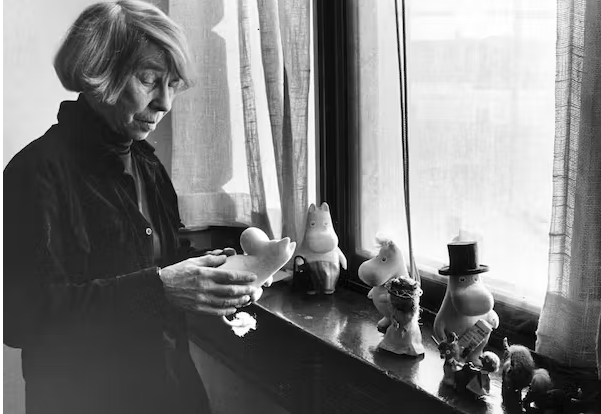
Tove Jansson with her Moomin trolls in 1981. TT News Agency / Alamy
The case for playing
The natural landscape of the tiny island is not just the backdrop to this precious novel, it also an important character itself. It is loud with the neverending wind, volatile with unexpected storms, and resilient like the moss and flowers that carpet the ground. The island is a small self-sufficient female universe, ruled by Sophia and Grandmother.
Sophia’s father, Papa, is there in the background, as reassuringly present as the landscape itself, yet silent. The dialogue is only between Sophia and Grandmother, occasional visitors and sometimes God. “Dear God, let something happen,” Sophia prays. “God, if You love me. I’m bored to death. Amen.”
Life on the island is a reminder of a simpler life that wasn’t simple at all. It is not described as an idyllic retreat from urban life – there is no electricity, the weather is temperamental, the sea can be deadly – and yet The Summer Book will leave you yearning for the chance to live a slower-paced, more deliberate, self-reliant life.
Snork Maiden, a Moomin character. Olga Popova / Shutterstock The coexistence of humanity and nature is one of the recurring themes in Jansson’s art, and on her island the two are in harmony. And if you are looking for yet another takeaway from this book, it must be this: to be inspired to live life as Sophia and Grandmother do on the island, with profound respect for their surroundings, and a joyous will to play – no matter what age you are.
And what better time to be reminded of this than when the sun is shining, the days are longer and the living is easier? For me, this book took me back to my own childhood and summers spent with my Danish family in a summerhouse not so different from Sophia and Grandmother’s.
With wild winds, unforgiving downpours and a brutally cold sea, time spent on the beach could be challenging. In response to my own (frequent) moaning, my grandmother, with the same unsentimental affection as Sophia’s, would shush me by saying: “Life is not easy, but it’s very interesting.”
And this is why we read books like The Summer Book. To remind ourselves of who we used to be, and of who we want to become.Reference Written by Barbara Tesio-Ryan Provided by The Conversation
※ Picks respects the rights of all copyright holders. If you do wish to make material edits, you will need to run them by the copyright holder for approval.
more from
The Conversation
The Conversation
How pecans went from ignored trees to a holiday staple - the 8,000-year history of America's only native major nut crop
2025-11-21 00:00:00
The Conversation
The fire is out, but Tongariro is now at risk of losing its unique biological legacy
2025-11-20 00:00:00
The Conversation
'Reduced air pollution is making clouds reflect less sunlight'
2025-11-20 00:00:00
The Conversation
Asbestos has been found in children's coloured sand. What’s the risk to kids?
2025-11-19 00:00:00
BEST STORIES
The Conversation
Asbestos has been found in children's coloured sand. What’s the risk to kids?
2025-11-19 00:00:00
Travie
Unzen Onsen: Japan's Fiery Paradise for Relaxation and Reflection
2025-11-19 00:00:00
Knowable Magazine
'Flying with whales: Drones are remaking marine mammal research'
2025-11-16 00:00:00
McArthurGlen
A taste of magic
2025-11-16 00:00:00
Lifestyle
The Conversation
Why are women's shoes so pointy? A fashion expert on impractical but stylish footwear
2025-11-19 00:00:00
The Conversation
Why two tiny mountain peaks became one of the internet's most famous images
2025-11-19 00:00:00
The Conversation
New global research shows eye movements reveal how native languages shape reading
2025-11-17 00:00:00
The Conversation
What is time? Rather than something that 'flows,' a philosopher suggests time is a psychological projection

 Reference