'Thoreau the scientist' - how environmental research informed 'Walden' and later works
by The Conversation
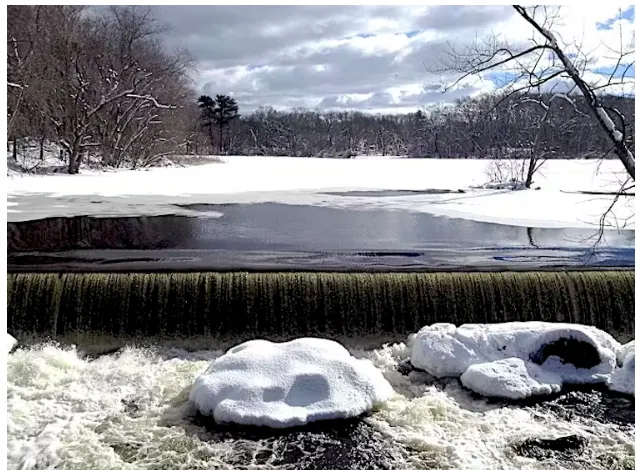
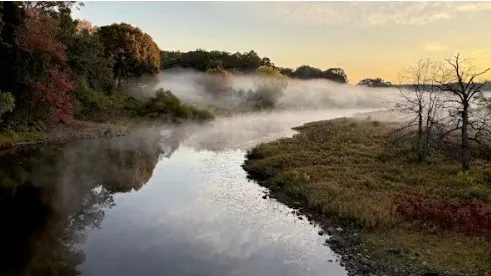
Henry David Thoreau investigated the Sudbury River as America’s first river scientist. Robert M. Thorson
The steam locomotive chugged its way toward Cambridge, Massachusetts, on Aug. 15, 1859. On board was an impatient young scientist wanting to understand the math and science governing how river channels should behave. After disembarking at Harvard College and searching the stacks of its library, Henry David Thoreau checked out “Principes D’Hydraulique,” a three-volume tome of hydraulic engineering.
Once he translated and transcribed 17 pages from the original French, he finally discovered what he was looking for: an equation for the equilibrium velocity of a stream, given its shape, slope, volume of flow and bed roughness.
This theoretically minded, quantitative side of Thoreau is nearly invisible in the cultural zeitgeist. There, his other side dominates: the famous 19th-century transcendental nature writer, philosopher, social critic and abolitionist who lived for two years in a small house in the woods above Walden Pond in Concord, Massachusetts.
This literary-minded, qualitative Thoreau is canonized and mythologized for “Walden,” a foundational text for America’s environmental movement, and for “Civil Disobedience,” which describes a model of nonviolent political protest later adopted by Emma Goldman, Mahatma Gandhi, Martin Luther King Jr. and many others.
Removal of this low factory dam across the Concord River in Billerica, Mass., was the center of contention for what may have been America’s first major environmental assessment. Robert M. Thorson
The nearly invisible Thoreau – the compulsively quantitative and analytically rigorous physical scientist – emerged from my research as a geologist interested in the history of 19th-century science. With two decades of scholarly books and articles behind me, I’m now featuring this less well-known Thoreau in my upcoming book, “The Walden Experiments: The Science of Henry David Thoreau.”
Footnote to fame
Thoreau rose to fame as an original American thinker. He’s now the star of an award-winning video game. The Thoreau Alliance, an organization dedicated to educating about his life and legacy, is international. A recently released and highly acclaimed Ken Burns-Ewers brothers biopic, “Henry David Thoreau,” focuses on the usual side of Thoreau as a writer and activist, emphasizing his focus on environmental justice, sustainable living and the power of nature to heal our increasingly technological and frenetic lives.
I served as an adviser for and appear in the film, which touches on Thoreau’s science. These touches are limited mainly to his work as a biological naturalist. Examples include his pioneering insights on the dispersal of seeds, his anticipation of Charles Darwin’s theory of natural selection and his study of the seasonal manifestations of natural phenomena, such as plants’ flowering times and bird migrations.
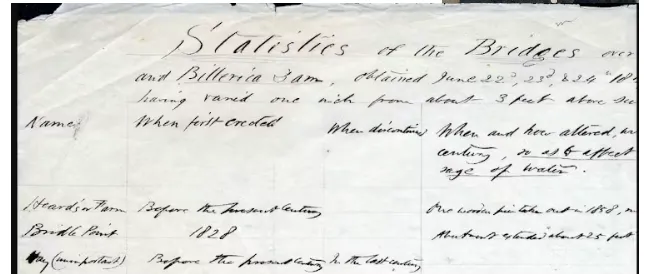
The fourth draft of a hand-inked table titled ‘Statistics of the Bridges…’ about the Concord River, prepared by Thoreau as part of a legal case in 1859. Courtesy Concord Free Public Library. Survey 133b.
Physical science
“I keep out of doors for the sake of the mineral, vegetable, and animal in me.”
Thoreau wrote this entry in his journal on Nov. 4, 1852, when he was busy researching the lake at Walden Pond. His words remind readers that any search for meaning must ultimately begin with the bedrock roots of their lives on which all plants, animals and cultures depend. My way of saying the same thing is, “No rocks, no ecosystems, no cultures.”
During his research on the lake and nearby streams, Thoreau made an original discovery in fluid mechanics. On June 4, 1854, he wrote the first known technical description of a standing capillary wave: a small water wave that, instead of rippling outward, stays in a fixed position.
This phenomenon, which he later made a technical drawing of, is now known as the Thoreau-Reynolds Ridge. His co-discoverer, Osborne Reynolds, was a pioneering Irish-British hydraulic engineer.
Limnology and geology
Thoreau also pioneered limnology, the science of lakes. He studied how light passed through the water of Lake Walden in liquid, solid and vapor phases, how the lake stored heat in stable layers during the summer and winter, how the water chemistry affected its clarity, and how lakes eventually fill to become dry land.
Thoreau correctly interpreted that his New England landscape had been shaped by a colossal ice sheet that had flowed southward from Canada. At the time, the state geologist of Massachusetts and the American science establishment were incorrectly attributing the same landscape to an iceberg-laden catastrophic flood. He also correctly reasoned that his beloved Walden Pond was born when a buried remnant of that ice sheet melted downward to create a groundwater-filled sinkhole called a kettle.
He kept a growing reference collection of rocks and minerals in his attic garret that was later exhibited for decades at the nearby Fruitlands Museum in Harvard, Massachusetts. His journal entries are peppered with geological insights related to these specimens. His final journal entry is a geological interpretation of rain splash erosion.
Thoreau’s river science
The most analytically rigorous science of Thoreau’s life culminated with his 1859 research trip to the library stacks of Harvard College. At the time, he was investigating how the Concord River watershed had changed in response to the construction of a downstream factory dam a century earlier.
Thoreau’s research was a clandestine part of a protracted legal case involving four acts of the state Legislature between 1859 and 1862. Potentially, this was America’s first major environmental assessment because it examined alternative actions to dam removal and weighed environmental protection against socioeconomic costs.
During a span of 18 months, Thoreau carried out nearly 50 discrete research tasks to create dozens of tables of numerical data and a detailed compilation map of the Concord River Valley that’s over 7 feet long. His river science predates that of the United States’ first recognized river scientist by 18 years.
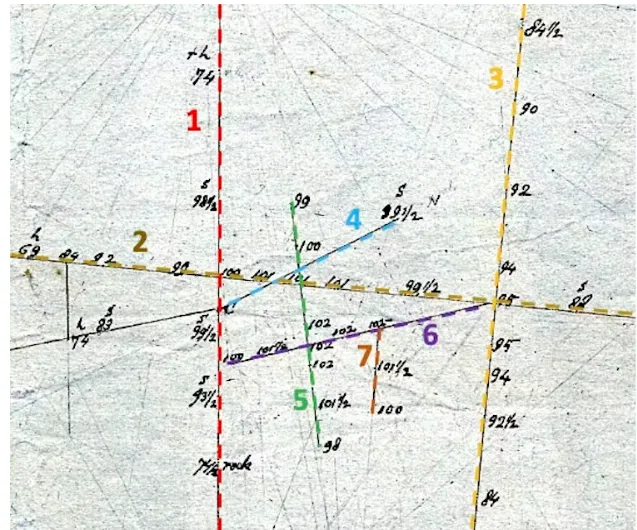
A colorized sequence of seven survey lines on a detail of Thoreau’s draft bathymetry of Walden Pond. He was searching for its deepest point. Courtesy Concord Free Public Library. Survey 133b.
The boldest claim of my latest book is that Thoreau’s sharp swerve toward science in 1851-52 led to the rescue of “Walden,” his most famous work. Specifically, his field research led to an understanding of its namesake place as a natural system of water, air, land, aquifer and life that included humanity. This more complex and inclusive vision transformed what had been an abandoned draft of social critique into the nature writing that became a foundational text for America’s environmental movement.
The Thoreau who built literary castles in the air put the solid foundations of physical science beneath them.
※ Picks respects the rights of all copyright holders. If you do wish to make material edits, you will need to run them by the copyright holder for approval.
more from
The Conversation
The Conversation
How tarot readers are using AI – and what it says about our growing reliance on chatbots for emotional support and advice
2026-05-16 00:00:00
The Conversation
Bottom trawling is scraping oceans of wildlife
2026-05-16 00:00:00
The Conversation
Protecting pollinating insects could improve diets and livelihoods worldwide – new study
2026-05-15 00:00:00
The Conversation
We tested the new World Cup ball – this is what you need to know about how it will fly, dip and swerve
2026-05-15 00:00:00
BEST STORIES
The Conversation
The '100‑day cough' that adults often miss
2026-05-10 00:00:00
KoreaJoongAngDaily
Bingsu for one: Retailers role out small-portion food products as inflation fuels 'micro consumption'
2026-05-10 00:00:00
Travie
Play Baseball, Meet Cats: Jeju's Wildest New Theme Parks Are Open
2026-05-10 00:00:00
Knowable Magazine
Do you take after your dad's RNA?
2026-05-12 00:00:00
Environment
The Conversation
New research highlights how wildfires are harming fish
2026-05-15 00:00:00
The Conversation
Other countries can learn from the UK’s successful shift to fortnightly bin collections
2026-05-15 00:00:00
The Conversation
Suspending federal gas tax wouldn’t save drivers as much as they might hope – here’s what goes into the price of a gallon of gas
2026-05-14 00:00:00
The Conversation
'Seismic whiplash'- new research shows what happens when earthquakes stop suddenly
 Henry David Thoreau investigated the Sudbury River as America’s first river scientist. Robert M. Thorson