'Squeak up! I can't hear you' : pilot whales are shouting to hear themselves over ship noise
by The Conversation
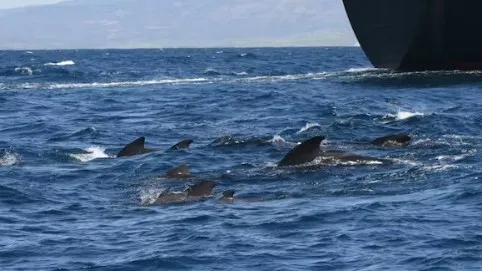
A pod of long-finned pilot whales near a cargo ship. CIRCE
In the Strait of Gibraltar – a famous marine road connecting the Mediterranean and the Atlantic – lives a critically endangered sub-population of a few hundred long-finned pilot whales (Globicephala melas).
Despite their name, these dark and blubbery marine mammals aren’t technically whales – they’re large oceanic dolphins which are believed to have a navigator or lead for each pod. Hence the “pilot” part of their name.
There are two types of pilot whales – short and long-finned. They’re generally found in deep offshore waters but can appear in coastal areas. And like other dolphins, they use high frequency sounds to talk to each other in their pods. These clicks and squeaks travel shorter distances compared with the melodic songs of humpback whales.
And as a new paper led by Milou Hegeman from Aarhus University in Denmark and published in the Journal of Experimental Biology shows, the pilot whales that live in the Strait of Gibraltar are having to shout at the upper limit of their range in order to hear each other over human noises.
What’s making all that noise?
The ocean is full of sounds.
Some of these are natural, such as the sounds from fish, seals and waves. Other sounds are produced by human activities, either deliberately (for example seismic and sonar exploration) or unintentionally (for example, the sound of moving ships or other vessels).
The ocean continues to get noisier because of human-made sound – even in isolated Arctic regions. And because of its strategic location, the Strait of Gibraltar is especially noisy with the drone of cargo ships.
Spying on pilot whales
To investigate the communication and behaviour of the population of pilot whales in the Strait of Gibraltar, scientists used 6-metre poles to attach small tags to the creatures (kind of like an Airtag used to track your suitcase) with sterile suction cups positioned between the dorsal fin and blowhole.
Between 2012 to 2015, the steam attached tags to 23 different long-finned pilot whales who live in the region year-round.
These tags remained on pilot whales for up to 24 hours collecting sounds and tracking individual behaviour. The tags then floated to the surface where scientists could locate them using an antenna and collect the data from their diving activities.Two long-finned pilot whales with recorders. CIRCE
More than 84 hours of recordings were made, with 1,432 pilot whale calls extracted. The tags also recorded ship noise in the area.
The researchers found there was a scarcity of pilot whale calls during periods of shipping noise. And the volume of the calls they did make were louder by about half the increase in background noise.
This means the animals are adapting to communicate in times when it is noisy – kind of like having a conversation in a crowded place and you having to raise your voice to be heard.
Other noises, other impacts
This study focuses on just one location in the ocean. But there’s increasing evidence that human-made noise is also impacting other species in other places.
For example, a 2012 study found that ship noise increases stress in right whales. Another study from 2024 found sea turtles travelling in the Galapagos were more vigilant because of increased ship noise.
But it’s not just ship noise that is impacting the animals that live in the ocean. Sonar disrupts whale diving behaviour and feeding behaviour, sometimes even potentially resulting in strandings.
This new study is just one of many scientific contributions to learning more about our impact on our blue backyard. We can only protect what we know. And as we celebrate the 100th birthday of Sir David Attenborough, it’s worth remembering one of his many pieces of wisdom: “If we save the sea, we save our world”.
Part of this involves being more aware of sound in our sea. Because sometimes, it’s not always the visible impacts such as plastic pollution that need our attention. It might also be the impacts we can only hear.
Reference Written by Vanessa Pirotta Provided by The Conversation
※ Picks respects the rights of all copyright holders. If you do wish to make material edits, you will need to run them by the copyright holder for approval.
more from
The Conversation
The Conversation
How tarot readers are using AI – and what it says about our growing reliance on chatbots for emotional support and advice
2026-05-16 00:00:00
The Conversation
Bottom trawling is scraping oceans of wildlife
2026-05-16 00:00:00
The Conversation
Protecting pollinating insects could improve diets and livelihoods worldwide – new study
2026-05-15 00:00:00
The Conversation
We tested the new World Cup ball – this is what you need to know about how it will fly, dip and swerve
2026-05-15 00:00:00
BEST STORIES
The Conversation
The '100‑day cough' that adults often miss
2026-05-10 00:00:00
Mindswitch
Crispy Golden French Fries
2026-05-11 00:00:00
Inven Global
Pearl Abyss Adds Difficulty Settings to 'Crimson Desert'
2026-05-11 00:00:00
Street Food Guy
How Digital Tools Are Changing the Way Travel Creators Share Food Culture
2026-05-15 00:00:00
Environment
The Conversation
New research highlights how wildfires are harming fish
2026-05-15 00:00:00
The Conversation
Other countries can learn from the UK’s successful shift to fortnightly bin collections
2026-05-15 00:00:00
The Conversation
Suspending federal gas tax wouldn't save drivers as much as they might hope - here's what goes into the price of a gallon of gas
2026-05-14 00:00:00
The Conversation
'Seismic whiplash'- new research shows what happens when earthquakes stop suddenly
 A pod of long-finned pilot whales near a cargo ship. CIRCE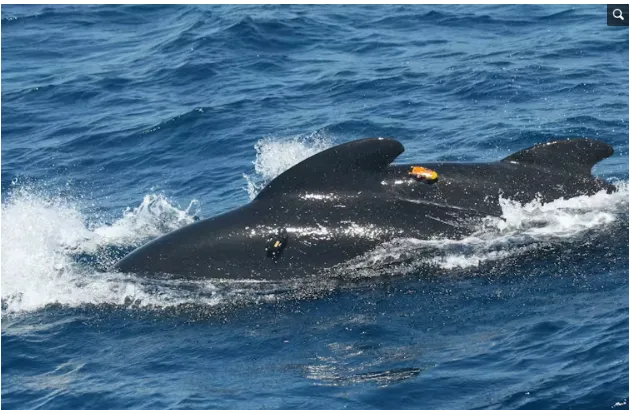
 Reference