Are aliens real? Scientists have been hunting for extraterrestrial life since the time of Aristotle
by The Conversation
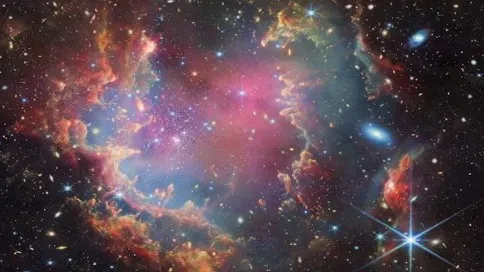
NGC 602, a young star cluster in the Small Magellanic Cloud, where astronomers using the James Web Space Telescope have found candidates for the first brown dwarfs outside of our galaxy. (ESA/Webb, NASA & CSA, P. Zeidler, E. Sabbi, A. Nota, M. Zamani)
Do aliens exist? Could Earth really be the only planet hosting intelligent life?
The tools generating the evidence within western science, however, have changed — from the philosophical and theological arguments of the Ancient Greeks to the development of increasingly sophisticated telescopes and space travel and exploration.
NASA’s Mars missions, clockwise from top left: Perseverance rover and Ingenuity Mars helicopter, InSight lander, Odyssey orbiter, MAVEN orbiter, Curiosity rover, and Mars Reconnaissance orbiter. (NASA/JPL-Caltech)
Philosophy and theology
Aristotle’s views on the nature of the cosmos dominated the Ancient Greek world. He argued that there’s only one world, at the centre of which is an immobile Earth. The planets move around the Earth. Beyond them is the sphere of the stars, or heaven.
“It is clear then that there is neither place, nor void, nor time, outside the heaven,” he wrote in On the Heavens. “Hence whatever is there, is of such a nature as not to occupy any place, nor does time age it.”
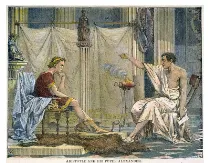
Aristotle’s teachings later created a storm in the Catholic Church, with various theologians worrying that Aristotle’s ideas were becoming too dominant. Étienne Tempier, bishop of Paris, responded to these criticisms by issuing the Condemnation of 1277, prohibiting the teaching of some 219 propositions — many of them derived from the teachings of Aristotle — and warning that those who disobeyed could be excommunicated.Aristotle teaching Alexander the Great. An 1866 engraving by Charles Laplante, a French engraver and illustrator. (Wikimedia Commons)
One theologian who pushed the argument about omnipotence further was Nicholas of Cusa. In his book, Of Learned Ignorance, published in 1440, he explicitly speaks of a plurality of inhabited worlds.
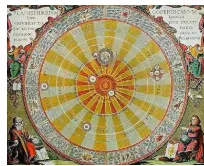
The invention of the telescope in the early 17th century gave this notion further impetus. The telescope revealed, for example, that the moon is not perfectly spherical as Aristotelians believed, but is covered by craters and mountains and so is quite Earth-like. Nicolaus Copernicus’ Heliocentric Solar System. (Wikimedia Commons)
By the end of the century, Bernard Le Bovier de Fontenelle had penned the first “scientific blockbuster,” Conversations on the Plurality of Worlds. Fontenelle speculated about living beings on all the planets of our solar system, as well as on planets orbiting other stars.
There was, however, little empirical evidence for these claims — a situation that would persist until after the Second World War.
The race to Mars
After the Second World War, national governments started to pour money into science, which was now seen as crucial to national well-being, and both astronomy and planetary science boomed.
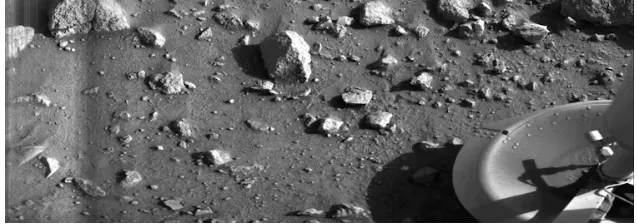
In 1964, the U.S. launched the Mariner 4 on a mission to Mars. The spacecraft flew by Mars in July 1965, taking the first photos of another planet from space. Instead of evidence of canals, these 21 photographs revealed the planet to have a cratered, moon-like surface.
The first photograph taken on the surface of Mars, by NASA’s Viking 1 spacecraft, in July 1976. (NASA/JPL)
The James Webb Telescope
We now tackle the question of extraterrestrial life with even more powerful scientific tools. In 1995, astronomers Michel Mayor and Didier Queloz discovered the first planet orbiting a sun-like star, named “51 Pegasi b” or “Dimidium.”
The James Webb Space Telescope, located beyond the moon and some 1.5 million kilometres from Earth, is investigating the atmospheres of some of these exoplanets.
The Earth’s atmosphere blocks most of the infrared light from astronomical objects reaching Earth-bound telescopes. But the James Webb’s location enables its giant mirror to gather infrared light, which the spacecraft’s instruments then analyze, allowing astronomers to learn about the composition of exoplanet atmospheres.
The telescope has also employed instruments that block the light of the star around which an exoplanet is travelling so that the exoplanet itself can be imaged. There is as yet no confirmed evidence of life in an exoplanet’s atmosphere.
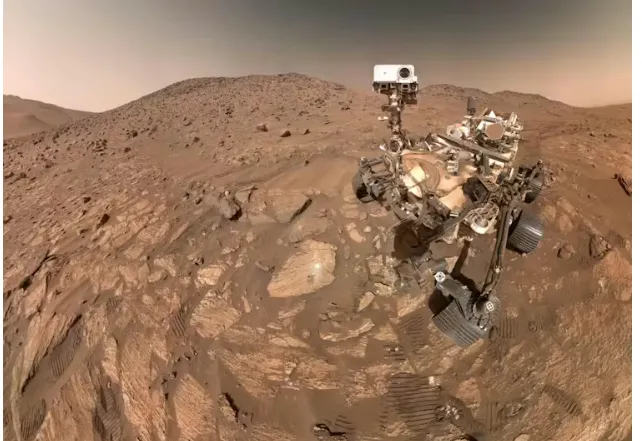
A selfie (made up of 62 images) taken by NASA’s Perseverance rover, against the backdrop of a rock called Cheyava Falls, which shows signs of possible signatures of previous organic life. (NASA/JLP-Caltech/MSSS)
In 2025, however, a paper published in Nature claimed that a rock sample taken from an ancient dry riverbed in Jezero Crater on Mars by NASA’s Perseverance Mars rover could contain “potential biosignatures” of ancient microbial life.
※ Picks respects the rights of all copyright holders. If you do wish to make material edits, you will need to run them by the copyright holder for approval.
more from
The Conversation
The Conversation
Ancient teeth reveal clues to the environment humans’ early ancestors evolved in millions of years ago
2026-04-21 00:00:00
The Conversation
Here’s how using more recycled plastic could ease the pain of oil shocks
2026-04-21 00:00:00
The Conversation
New research finds few improvements for British Columbia’s endangered wildlife
2026-04-21 00:00:00
The Conversation
Washington DC's 240 million‑gallon sewage spill is a symptom of nationwide trouble
2026-04-20 00:00:00
BEST STORIES
Knowable Magazine
The crazy nests built by leaf-cutter ants
2026-04-17 00:00:00
KoreaJoongAngDaily
Warmer weather in Korea has diners spilling into the streets for 'yajang'
2026-04-17 00:00:00
Travie
Thailand's World's Biggest Songkran Festival 2026 Announced
2026-04-20 00:00:00
AllblancTV
Only 10 MIN! Full Body Fat Burning Workout (1/3)
2026-04-20 00:00:00
Lifestyle
The Conversation
Electric vehicles pass tipping point, breaking the link with oil prices
2026-04-20 00:00:00
The Conversation
Why Europe can still face a gas crisis without a gas shortage
2026-04-18 00:00:00
The Conversation
What is the chance of a message in a bottle being found?
2026-04-18 00:00:00
The Conversation
It's right under your nose - why some people can't find things in plain sight
 NGC 602, a young star cluster in the Small Magellanic Cloud, where astronomers using the James Web Space Telescope have found candidates for the first brown dwarfs outside of our galaxy. (ESA/Webb, NASA & CSA, P. Zeidler, E. Sabbi, A. Nota, M. Zamani)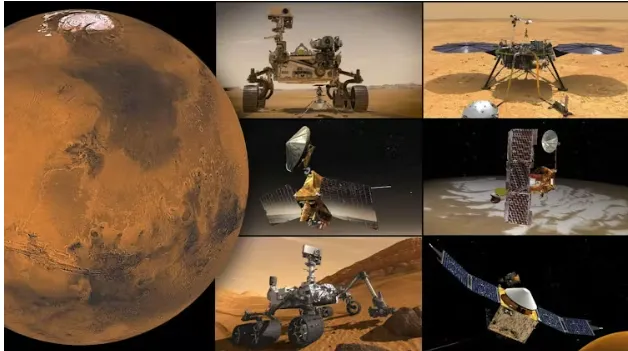
 Reference