Artemis II crew brought a human eye and storytelling vision to the photos they took on their mission
by The Conversation
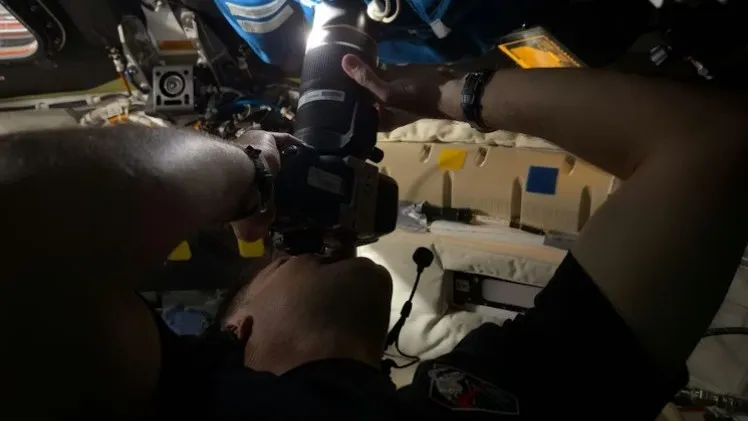
Astronaut Jeremy Hansen takes a picture through the camera shroud covering a window on the Orion spacecraft. NASA
In early April 2026, the Artemis II mission captivated me and millions of people watching from across the world. The crew’s courage, skill and infectious wonder served as tangible proof of human persistence and technological achievement, all against the mysterious backdrop of space.
People back on Earth got to witness the mission through remarkable photos of space captured by astronauts. Images created and shared by astronauts underscore how photography builds a powerful, authentic connection that goes beyond what technology alone can capture.
As a photographer and the director of the Rochester Institute of Technology’s School of Photographic Arts and Sciences, I am especially drawn to how these photographs have been at the center of the public’s collective experience of this mission.
In an era when image authenticity is often questioned and with the capabilities of autonomous, AI-driven imaging, NASA’s choice to train astronauts in photography has placed meaning over convenience and prioritized their human perspectives and creativity.
Capturing space from the crew’s perspective
Photography was not originally placed as a high priority in NASA’s Apollo era. The astronauts only took photographs if they had the chance and all their other tasks were complete.
‘The Blue Marble’ view of the Earth as seen by the Apollo 17 crew in 1972. NASA
This excitement could be explained by the novelty of photos from space, but these images also distinguish themselves as products of astronauts experiencing these sights and interpreting them through their photographs. These differences require an important distinction around where technology ends and humanity begins.
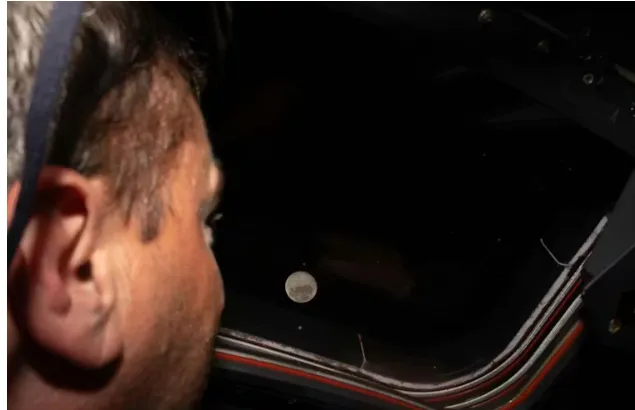
NASA astronaut Reid Wiseman watches the Moon from one of the Orion spacecraft’s windows. NASA
Human perspective versus AI tools
Photography has long integrated AI-powered software and data-driven tools in a variety of ways: to process raw images, fill in missing color information, drive precise focus and guide image editing, among others. These modern technological assists help human photographers realize their vision.
And AI can generate convincing, realistic images and videos from nothing more than a text prompt, using readily available tools.
Researchers train AI to mimic patterns informed by millions of sample images, and the algorithm can then either take or create a photograph based on what it predicts would be the most likely version of a successful, believable image.
Human-created photos are rooted in direct observation, intent and lived experience, while AI images – or choices made by AI-driven tools – are not. While both can produce compelling and believable visuals, the human photographs carry emotional power because the photographer is drawing from their experiences and perspective in that moment to tell an authentic story.
Artemis II photographs resonate, not only because they are historic, but because they reflect the deliberate choices and intent of a human being in that specific moment and context. The exposure, camera setting, lens choice and composition are all dictated by the astronaut’s vision, skill, perspective and experience. Each image is unique in comparison with the others. These choices give the images narrative power, anchoring them in human perspective.
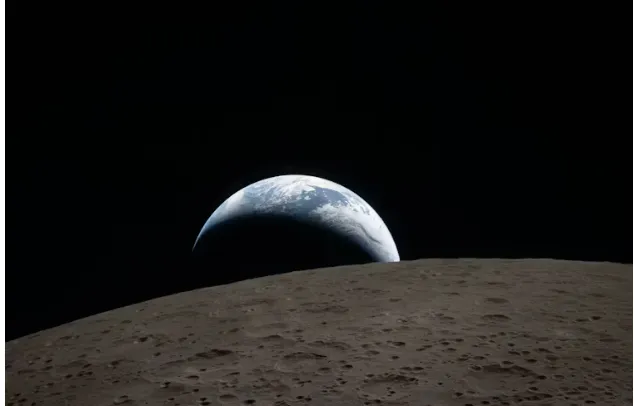
NASA’s ‘Earthset’ photo captured by the Artemis II crew. NASA
Images to tell a story
Photographers choose what to include in the final version of their image to tell a story. In the Artemis II images, this human perspective comes out. In the “Earthset” photo, you see a striking juxtaposition of the Moon’s monochromatic, textured surface in the foreground against a slivered, bright Earth.
The choice to include both in the frame contrasts these objects literally and figuratively, inviting comparison. It creates a narrative where Earth is contrasted against the Moon – life is contrasted against the absence of it.
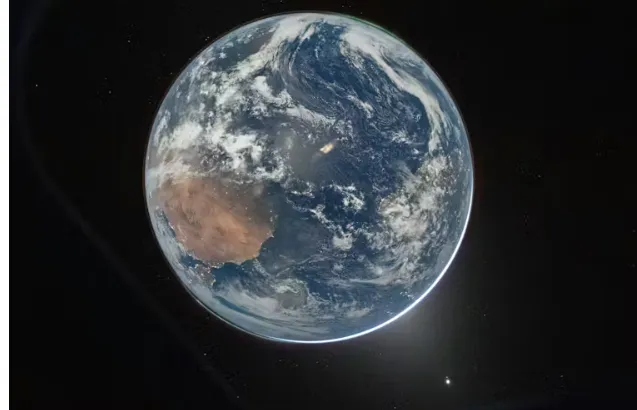
Another photo shows the nightside of the whole Earth, featuring the Sun’s halo, auroras and city lights. The choice to include the subtle framing of the window of the capsule in the lower left corner reminds the viewer where and how this image was captured: by a human, inside a capsule, hurtling through space. That detail grounds the photograph in the human perspective.
The Artemis II crew’s ‘Hello World’ image shows the side of the Earth not illuminated by the Sun at the time of photographing. NASA/Reid Wiseman
Both photos are reminiscent of Earthrise and the Blue Marble. These past images hold a place in the global collective consciousness, shaped by a shared historical moment.
The Artemis II photographs are anchored in this collective moment of lived human experience, yet also shaped by each astronaut’s viewpoint. The crew’s unique perspectives exemplify photography’s transformative power by inviting viewers to engage emotionally and intellectually with their journey. These photographs share the astronauts’ awe and wonder and affirm the value of human creativity and its ability to connect us in a captured moment.
Reference Written by Christye Sisson Provided by The Conversation
※ Picks respects the rights of all copyright holders. If you do wish to make material edits, you will need to run them by the copyright holder for approval.
more from
The Conversation
The Conversation
'Gray whales are dying in San Francisco Bay at an alarming rate - this isn't normal'
2026-04-16 00:00:00
The Conversation
It's right under your nose - why some people can't find things in plain sight
2026-04-16 00:00:00
The Conversation
'Bouncing back' is a myth - resilience means integrating hard experiences into your life story, not ignoring them
2026-04-16 00:00:00
The Conversation
Five warning signs that rivers are polluted - even when they look clean
2026-04-16 00:00:00
BEST STORIES
KoreaJoongAngDaily
Why 'English kindergartens' remain popular in Korea despite rising costs and government crackdowns
2026-04-14 00:00:00
The Conversation
'How AI's language barrier limits climate disaster responses'
2026-04-14 00:00:00
Mindswitch
A misty morning by the river
2026-04-12 00:00:00
Inven Global
VALORANT Masters Santiago Swiss Stage concludes as playoffs bracket takes shape
2026-04-13 00:00:00
Environment
The Conversation
'Do beaver dams really make flooding worse? Research casts doubt on beavers as flood culprits'
2026-04-15 00:00:00
The Conversation
NZ may be winning the fight against the invasive yellow‑legged hornet - but a crucial phase lies ahead
2026-04-15 00:00:00
The Conversation
Wildflower once used to treat wounds and sore throats shows promise in fighting dangerous superbugs
2026-04-14 00:00:00
The Conversation
The human body isn't a masterpiece of design - it's a patchwork of evolutionary compromise
 Astronaut Jeremy Hansen takes a picture through the camera shroud covering a window on the Orion spacecraft. NASA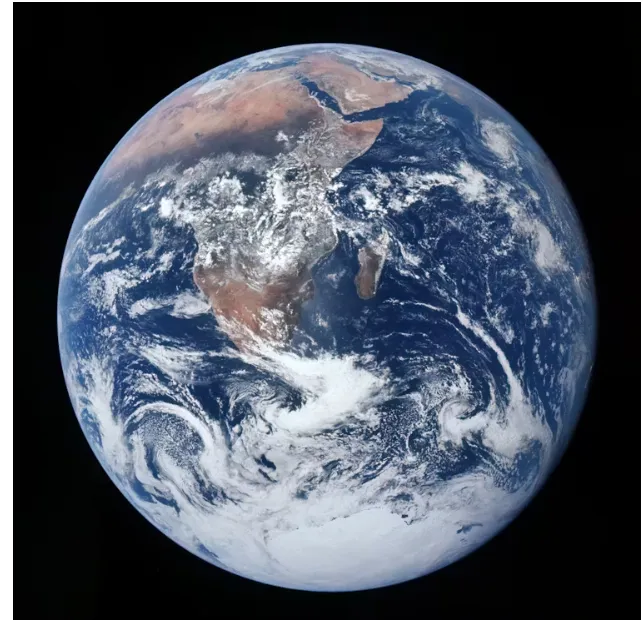
 Reference