You're not going to be alone in national parks this summer - enjoy the company
by The Conversation
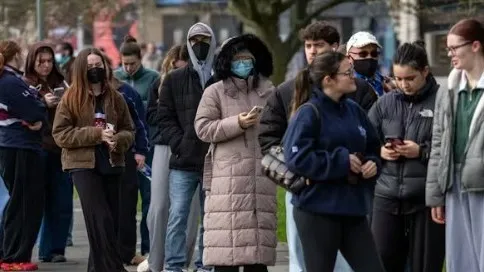
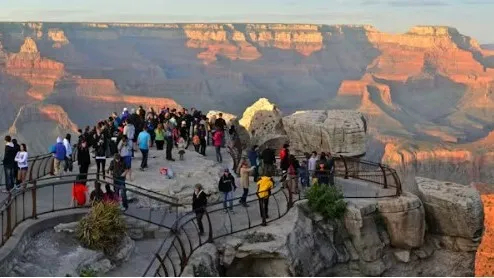
Are there too many people here? It depends on your perspective. Michael Quinn/National Park Service
On a summer morning a couple of years ago, we went for a hike on the fabled Bright Angel Trail, one of the most popular trails in Grand Canyon National Park.
As scholars of tourism and outdoor recreation, our conversation inevitably turned to the visitor experience at the Grand Canyon and a question that has plagued the parks since their inception: Are the national parks overcrowded?
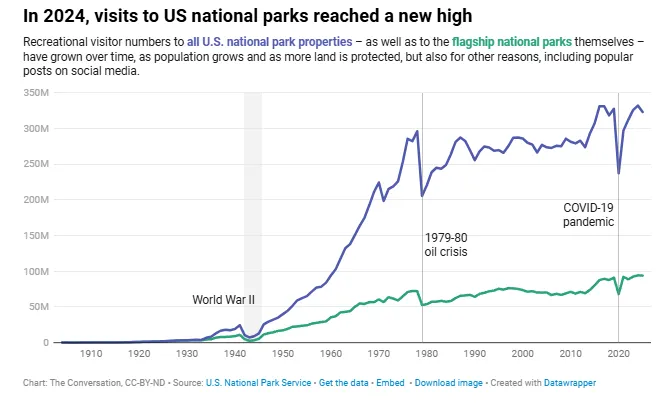
It’s not a simple question, but we believe that people have been answering it incorrectly for over a century, as many Americans have come to a decisive conclusion: Yes. Of course, some specific locations within parks can get overcrowded, and some people are more sensitive to crowding. But often people wrongly assume that a busy park means a crowded one, or that having other people around is inherently bad.
Old Faithful in Yellowstone National Park is a major attraction that many visitors to the park want to witness. Neal Herbert/National Park Service
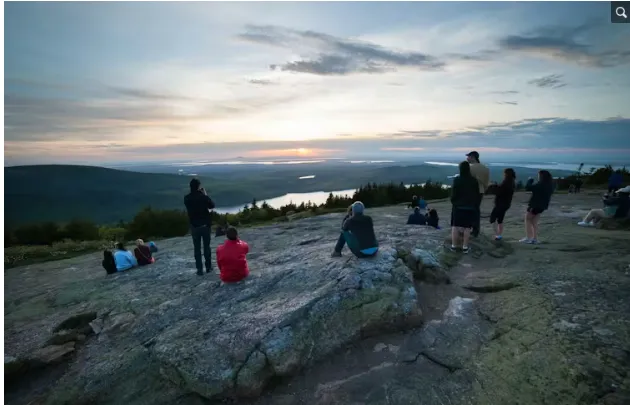
Watching the sunrise on Cadillac Mountain in Acadia National Park in Maine can be an enjoyable collective experience. Kent Miller/National Park Service
Beyond crowding, toward ‘communitas’
Hiking on the Bright Angel Trail that morning in 2023, we noticed vignettes that challenge the crowding assumption. The trail was busy. It was early, and the south wall of the canyon was still blanketed in shade. Two families, one hiking up, the other hiking down, were chatting and sharing insights at a bend in the trail.
A young hiker shared her binoculars with an elderly man, focusing them on a distant, rare desert bighorn sheep. An older couple smiled as a gaggle of kids ran uphill and past them, racing to the ice cream promised to them on the canyon rim. Another hiker pointed out a California condor sailing above. Together, we marveled at its beauty.
Despite the number of people on the trail, we did not feel crowded. Rather, we felt a spontaneous sense of community and togetherness. Anthropologist Victor Turner called this feeling “communitas,” a shared experience that a person might encounter during a pilgrimage, surrounded by other travelers with a shared journey and goal.
In fact, in 1922, more than a decade before Leopold’s lament about “over-crowded hospitals,” conservation advocate Robert Sterling Yard described the sharing of space and time as crucial elements of the national park experience. He noted that a person “sits around the evening camp fire with a California grape grower, a locomotive engineer from Massachusetts, and a banker from Michigan.” He continued: “Here the social differences so insisted upon at home just don’t exist. Perhaps for the first time, one realizes the common America – and loves it.”
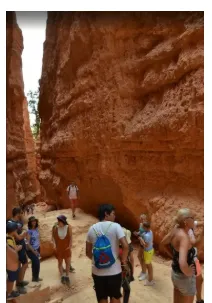
It’s a matter of perspectiveAre these crowds or prospective companions at Bryce Canyon National Park in Utah? Bing Pan, CC BY-NC-ND
It is important to remember that each person has the power to shift how they react to the number of people around them in parks. Being crowded is not an objective state; it is a negative perception of social conditions. For instance, when people see visitors as different from themselves, they are more likely to feel crowded. But by recognizing that tendency and reframing the interaction, people are more likely to find communitas.
Communitas, too, is in the eye of the beholder. When people view social interactions in parks as opportunities to share in a larger collective experience, they open up the possibility of experiencing communitas.
This summer, we urge you to enter America’s national parks with perhaps a different perspective. Experience the collective awe of watching Old Faithful erupt with a few hundred of your fellow pilgrims in Yellowstone National Park. Find wonderment in sharing a sunrise from Cadillac Mountain in Acadia National Park or sunset from Olmstead Point in Yosemite National Park. Seek the power that comes from seeing the Grand Canyon for the first time, together.
Most importantly, be the person who points out that condor, gives a neighboring camper that extra hot dog, or takes that photo for another family. Find your communitas, help others to do the same and, together, consider the grandeur of the shared experience of America’s national parks.
※ Picks respects the rights of all copyright holders. If you do wish to make material edits, you will need to run them by the copyright holder for approval.
more from
The Conversation
The Conversation
Bacterial meningitis is deadly, but can also have life‑altering long‑term effects – new study
2026-04-04 00:00:00
The Conversation
Why has it taken so long to return to the Moon?
2026-04-03 00:00:00
The Conversation
A global butterfly index could advance insect conservation worldwide
2026-04-03 00:00:00
The Conversation
Decades of putting others first - the toll it takes on women's bodies
2026-04-02 00:00:00
BEST STORIES
HapsKoreaMagazine
Seoul Unveils 175 Spring Flower Paths Across the City as Bloom Season Begins
2026-03-31 00:00:00
Mindswitch
Music to Accompany the City's Day
2026-04-01 00:00:00
AllblancTV
One Band is All You Need! Sculpt Your Back, Chest, Arms, and Shoulders (Part 2/2)
2026-03-30 00:00:00
Visit Dubai
New tourist attractions in Dubai that you must check out
2026-04-04 00:00:00
Environment
The Conversation
How California's war on smog and its ambitious car pollution rules made everyone's air cleaner
2026-04-02 00:00:00
The Conversation
Water flow in prairie watersheds is increasingly unpredictable - but AI could help
2026-04-02 00:00:00
The Conversation
As that new food caddy lands, here's how to reduce waste - not just recycle it
2026-04-01 00:00:00
The Conversation
AI makes rewilding look tame - and misses its messy reality
 Are there too many people here? It depends on your perspective. Michael Quinn/National Park Service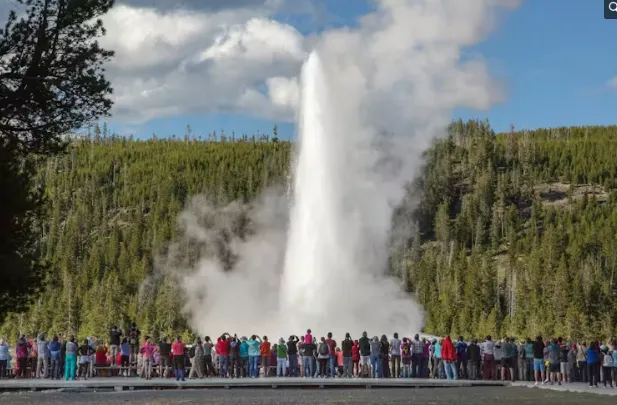
 Reference