The raccoon raiding your garbage bin might just be solving a puzzle-For the fun of it
by The Conversation
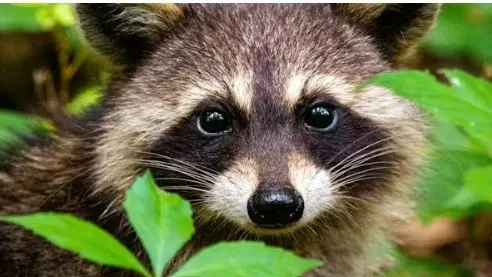
Raccoons are innovative problem-solvers, with a large number of neurons packed into a fairly small brain and highly dextrous forepaws. (Unsplash/Joshua Cotten)
Ever woken up to find that a crafty raccoon has overturned your garbage bin and spread the discarded contents of your life across the street?
Raccoons — sometimes referred to as “trash pandas” — are renowned as excellent innovators and problem-solvers who can often find their way through the trickiest barriers in their search for food.
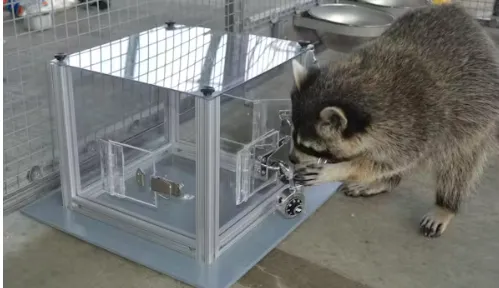
A raccoon working on opening a multi-solution puzzle box. (Hannah Griebling)
So how do raccoons adapt their problem-solving strategies as tasks become more difficult? And will they still engage in problem solving even if it doesn’t lead to a food reward? We designed a research experiment to find out.
Raccoons often engage in problem-solving when foraging in human-dominated areas, and have several adaptations that allow them to do this.
First, they have a high number of neurons packed into a relatively small brain. Their neuronal density is more similar to that of primates than other carnivores.
They also have highly dexterous forepaws adapted for foraging in streams, and a generalist diet that allows them to eat nearly everything we throw away.
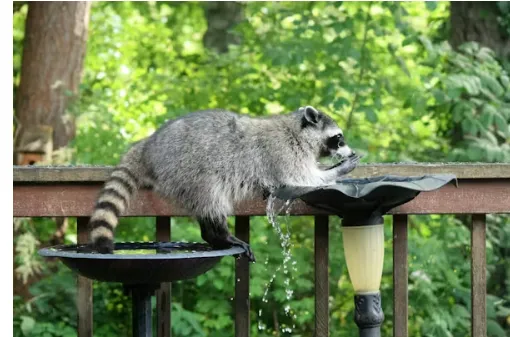
Raccoons frequently use human household equipment and technology for their own purposes. (Unsplash/Fr0ggy5)
As researchers, we were curious to discover whether raccoons change their strategies as problems become more difficult. For example, what does a raccoon do if the garbage bin is open, versus if it has a lid or if that lid is locked?
To explore these questions, we gave raccoons a multi-access puzzle box. These boxes are used in animal cognition research to study problem solving and innovation. They have multiple problems to solve so the animal can access a single food reward.
Typically, researchers give the animal a multi-access box and let the animal solve a puzzle of their choosing to access the reward. Then, the researcher locks that solution and the animal must innovate a new way into the box.
Instead of locking the solutions on the box we asked a simple question: What would happen if we left the box unlocked and let the raccoons freely interact with it? Would they keep going back to the same solution type that they already knew how to use, or would they explore and open new solution types?
Would they open the box once, get their food reward — a single marshmallow — and be done? Or would they keep playing with the box even after the food reward was gone?
A raccoon has successfully opened a turn knob solution on the multi-solution puzzle box and is working on removing an unlocked lock from the hasp latch. (Hannah Griebling)
Raccoons solve problems for fun
What the raccoons did was surprising. We expected them to find multiple solutions on the box. We did not expect them to continue looking for solutions after they found the single marshmallow inside the puzzle box.
They seemed to be intrinsically motivated to open multiple solutions within a 20-minute trial, even when solving the puzzle didn’t directly lead to a marshmallow reward.
In fact, the raccoons were discovering multiple solutions on the puzzle box even when the problems got more difficult to solve, and they could see and feel with their forepaws that there wasn’t another marshmallow in the box.
When the going gets tougher
As those problems became more difficult, the raccoons began to quickly hone in on a single solution to keep returning to.
This follows an exploration-exploitation trade off, where it’s more beneficial to exploit a single solution when the problems are more difficult, since solving them takes more time and effort from the raccoon.A raccoon works on a medium difficulty solution. (Hannah Griebling)
Imagine standing on a city street, feeling hungry. You see your favourite restaurant, where you love the food, and you see an interesting new one next door. Where do you choose to eat?
If that new restaurant down the street is expensive, you might be less inclined to try it over your favourite dish served at your usual place.
Success in ever-changing cities
This propensity to innovate and problem-solve, even when it doesn’t directly lead to an extrinsic reward like food, might be familiar to most of us. It’s what drives our desire to solve a crossword puzzle or conquer a new video game.
This intrinsic motivation could help raccoons succeed in urban environments. In cities, resources are often changing rapidly — one night a raccoon might get into someone’s garbage, and the next night there’s a brick on top of the garbage bin to try and keep the raccoon out.
The more problems raccoons learn to solve, the more they might be able to access resources in ever-changing cities. Of course, that might annoy some of us, but we can admire raccoons’ ability to thrive alongside us.
※ Picks respects the rights of all copyright holders. If you do wish to make material edits, you will need to run them by the copyright holder for approval.
more from
The Conversation
The Conversation
'Time to buy local' war fuel price shocks reveal the folly of a long food supply chain
2026-03-29 00:00:00
The Conversation
A brief history of denim - and why the 'perfect pair' of jeans remains elusive
2026-03-29 00:00:00
The Conversation
2026's historic snow drought brings worries about water, wildfires and the future in the West
2026-03-29 00:00:00
The Conversation
Land animals evolved from ocean ancestors - new study unravels the genetics behind the transition
2026-03-28 00:00:00
BEST STORIES
Travie
Best Night Cherry Blossom Spots in Incheon: 4 Hidden Spring Destinations After Work
2026-03-28 00:00:00
Knowable Magazine
Sweet! The cell's sugary coating comes into view
2026-03-25 00:00:00
Inven Global
Gen.G Sweep BNK FEARX 3–0 to Win LCK Cup 2026
2026-03-28 00:00:00
HapsKoreaMagazine
Gimhae to Host Spring Snow Blossom Festival on March 28–29
2026-03-25 00:00:00
Environment
The Conversation
'Climate change is altering Saharan dust - and Europe is downwind'
2026-03-28 00:00:00
The Conversation
'Waste being used to tackle erosion poses a health risk - an anthropologist explains the dilemma'
2026-03-28 00:00:00
The Conversation
Cyclone Narelle is now larger and 'more severe' as it crosses the Western Australian coast
 Raccoons are innovative problem-solvers, with a large number of neurons packed into a fairly small brain and highly dextrous forepaws. (Unsplash/Joshua Cotten)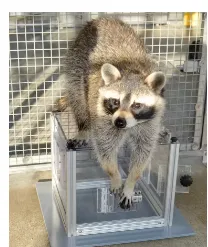
 Reference