'Seabirds struggled to raise chicks in the Hauraki Gulf this summer. What happened?'
by The Conversation
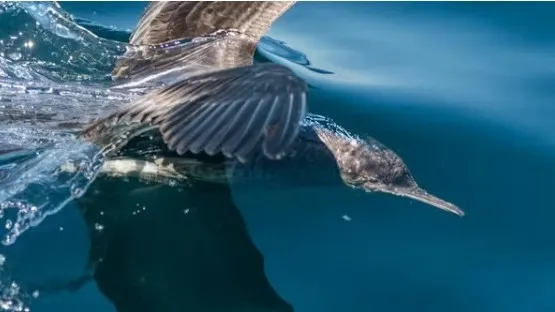
A fluttering shearwater foraging at sea. Edin Whitehead, CC BY-NC-ND
Some seabirds breeding in New Zealand’s largest marine park struggled to raise chicks this summer, most likely because climate change is forcing them to travel too far in search of food.
The Hauraki Gulf Tīkapa Moana is a global hotspot for seabirds. About 70 species breed and forage there, and five breed nowhere else in the world.
Our team has been monitoring nests of diving petrels and fluttering shearwaters in the gulf since October last year. We observed a 50% failure rate in the 13 fluttering shearwater nests we monitored at Tāwharanui, north of Auckland, compared to the usual rate of 36%.
In 2019, fluttering shearwaters in the gulf were foraging and returning to the nest daily, but in December 2025, they were disappearing for as long as 12 days. The adult birds left their nests for so long, we wondered if the colony could be wiped out.
Adult fluttering shearwaters left their nests for up to 12 days in search of food. Edin Whitehead, CC BY-NC-ND
Four of the adult shearwaters abandoned their nesting boxes, typically a sign they can’t find enough food to survive and feed their chicks. GPS tracking showed birds were making foraging trips as far as North Cape, more than 200 kilometres away.
Usually, shearwater parents rotate shifts, with one sitting on the egg, while the other flies out to forage, then swapping every day or two. But if there’s not enough food, the parent sitting on the egg can get too hungry to stay and will go to sea to feed.
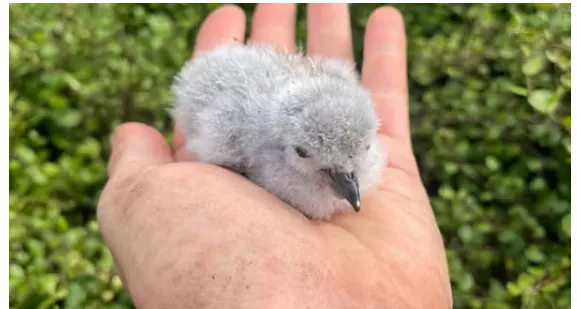
Without a parent incubating the eggs, the development of chicks slows down because it is cooler for longer periods. Fluttering shearwater chicks in the gulf usually hatch between late October and the end of November, but this season hatching didn’t begin until late November.
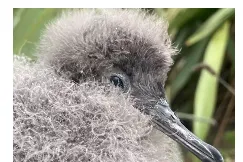
Fluttering shearwater chicks hatched unusually late this summer. Edin Whitehead, CC BY-NC-ND
Some shearwaters were sitting on eggs until mid-December, possibly because the eggs had been left to cool more often while the parents searched long distances for food.
This unusually late hatching is concerning because it is so different from what has been recorded previously for the species in the Hauraki Gulf. Our monitoring studies this summer show the outlook for these seabirds is bleaker than expected.
Late hatching, smaller chicks
We also observed diving petrel chicks hatching up to a month later than usual on Tiritiri Matangi Island.
We recorded lower than average weights among the 15 diving petrel chicks we monitored. They were a lot lighter than normal when they left their nests and therefore had less energy reserves. This may reduce their survival rate.
Diving petrel chicks left their nests with lower energy reserves. Edin Whitehead, CC BY-NC-ND
Seabirds are sensitive to changes in the ocean and offer an early warning of shifts that will affect other species in the Hauraki Gulf.
The global ocean is taking up more than 90% of the excess energy generated by rising carbon emissions, equal to 25 billion Hiroshima bombs since the 1960s. Marine heatwaves are already occurring more frequently, including in the Hauraki Gulf.
Warmer seawater affects zooplankton (tiny, drifting animals) in a number of ways. It drives them further south as they seek cooler waters and they become smaller and less nutritious.
This change in zooplankton disrupts the whole food web, including fish and seabirds. The impacts on seabirds are easy to observe, but everything in the gulf reliant on zooplankton will be affected.
We’re hoping some species will be able to cope with the higher ocean temperatures, but the warming already has a dramatic impact on the species we’ve monitored.
More and longer heatwaves in the gulf
If current emissions of carbon dioxide continue unabated, the World Meteorological Organisation projects global average temperatures will exceed 1.5°C above pre-industrial levels in the next five years.
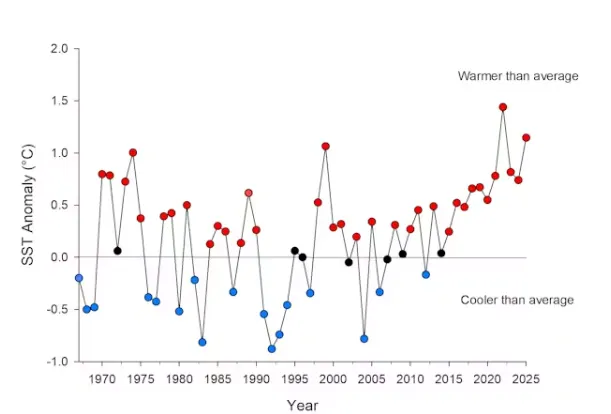
New Zealand has some of the fastest warming waters on the planet and the number of marine heatwaves has been rising in the Hauraki Gulf since 2012. In 2022, the gulf experienced its longest marine heatwave thus far and the warming trend continues.While seawater temperatures in the Hauraki Gulf have alternated between warmer and cooler years between 1967 and 2025, they have been consistently warmer during the past 12 years. This graph shows the sea surface temperature (SST) anomaly – how far each year deviated from the average baseline (red dots show warnner than average seawater, blue dots show cooler seawater). Data provided by Nick Shears, Leigh Marine Laboratory, CC BY-NC-ND
Apart from ocean warming and changes to zooplankton, seabirds are also affected by fisheries, particularly commercial fishing with purse seine nets that strip life from the sea.
Large shoals of big fish such as trevally and kahawai used to push up small fish and zooplankton to the surface frequently in the gulf. Seabirds could feast on these “boil-ups” but they have dwindled in size and frequency, making it harder for seabirds to feed themselves and growing chicks.
Coastal marine reserves work wonders, but many of the large fish that push prey to the surface are migratory. In order to protect migratory fish, marine protection would need to be mobile and seasonal. GPS tracking could indicate where seabirds are feeding and where temporary protection is needed.
Some change in the gulf is likely inevitable. But it is important to make these waters as naturally resilient as possible by minimising other human impacts, including sedimentation, pollution and overfishing.
We would like to acknowledge the contribution by Isabella Brown, who monitored diving petrels during the breeding season as part of her MSc research, and the Explore Group for supporting her access to Tiritiri Matangi.
※ Picks respects the rights of all copyright holders. If you do wish to make material edits, you will need to run them by the copyright holder for approval.
more from
The Conversation
The Conversation
Disaster inertia: why must NZ keep relearning the same lessons from extreme events?
2026-03-23 00:00:00
The Conversation
Why drawing eyes on food packaging could stop seagulls stealing your chips
2026-03-23 00:00:00
The Conversation
Dogs can overdose too: Naloxone training can save pets' lives as well as humans
2026-03-22 00:00:00
The Conversation
How plant populations keep a genetic memory of the past
2026-03-22 00:00:00
BEST STORIES
The Conversation
In war‑torn Iran, air pollution from burning oil depots and bombed buildings unleashes invisible health threats
2026-03-18 00:00:00
Knowable Magazine
A light in the dark: Finding the good in the natural world
2026-03-20 00:00:00
HapsKoreaMagazine
Spring Oysters In Korea Offer Sweeter Flavor And Fuller Texture
2026-03-22 00:00:00
AllblancTV
Melt Away Your Love Handles: Effective Waist-Slimming Workout (Part 2/2)
2026-03-22 00:00:00
Environment
The Conversation
You probably agree with the animals on which bird calls, frog noises and cricket chirps are most attractive – new research
2026-03-22 00:00:00
The Conversation
'Tracking wildlife using DNA: A scientific breakthrough made with an Indigenous community'
2026-03-21 00:00:00
The Conversation
'Why global methane levels spiked during COVID lockdowns'
2026-03-21 00:00:00
The Conversation
Paul Ehrlich, often called alarmist for dire warnings about human harms to the Earth, believed scientists had a responsibility to speak out
 A fluttering shearwater foraging at sea. Edin Whitehead, CC BY-NC-ND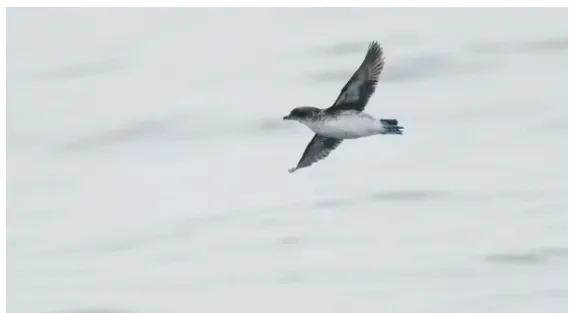
 Reference