Where did the ancient Greeks and Romans think lightning came from? Hint: not just the gods
by The Conversation
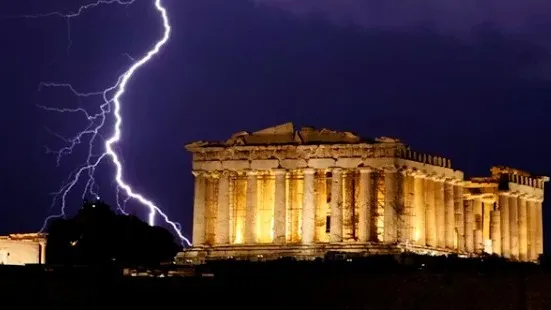
AP Photo/Petros Giannakouris
Is it any wonder ancient people thought lightning came from the gods? Even today a close lightning strike feels like a terrifying brush with the supernatural.
Some ancient thinkers, however, suspected the gods had nothing to do with it.
They wondered, centuries ahead of their time, if lightning was related somehow to the movement of air and clouds.
A reminder of power and wrath
In the mythology of ancient Greece and Rome, thunder and lightning strikes were the prime weapon of Zeus (the king of the gods, known to the Romans as Jupiter). Reminders of his power and wrath via lightning strikes were everywhere.
The ancient Greek poet Hesiod (who was writing around 700 BCE, about the same time as Homer) described Zeus hurling bolts of lightning and thunder at his divine enemies. Zeus also struck humans such as the mythical King Salmoneus as punishment for demanding his subjects worship him as a god.
Surviving Greek and Roman statues depict Zeus hurling lightning bolts as his chief weapon of power.
For the Romans, Jupiter and the gods more generally intervened dramatically in human affairs via lightning strikes. They were often a clear indication of divine displeasure.
The father of Pompey, one of Rome’s most powerful Republican generals, was killed in 87 BCE by lightning (according to one version of the story). He was conducting a military campaign in the middle of a civil war. According to the Roman writer Plutarch, Pompey’s father was one of Rome’s most hated generals. For many at the time, the gods had dispensed justice.
In about 125 CE, the well-travelled emperor Hadrian climbed Mount Casius in Syria to view the sunrise. When he offered a sacrifice to Zeus/Jupiter, to whom the mountain was sacred, a lightning bolt killed both the attendant and sacrificial victim. Hadrian himself was spared.
In 283 CE, the Roman emperor Carus wasn’t so lucky. He was struck and killed by lightning while on campaign against the Persians. One ancient account claimed Carus was killed because he campaigned further than the gods allowed.
In the fourth century CE, the Greek writer Libanius was struck by lightning while reading a play of Aristophanes. He would suffer from debilitating headaches and other afflictions for the rest of his life.
Complex rituals and a gift from the gods
Occasionally, lightning was sent by the gods to aid an emperor in battle. When Marcus Aurelius campaigned against a tribal group in the 160s CE, lightning bolts scattered the enemy.
According to the church historian, Eusebius, the legion accompanying him was, from then on, known as the thundering legion (Fulminata).
Roman religious practice ordered complex rituals surrounding the ground struck by lightning. In what was known as the Bidental Ritual, priests purified the affected spot. It was then sealed off and forbidden to be walked on or even looked at.
Even the emperor Constantine, a supporter of Christianity from early in his reign, ordered the performance of traditional pagan rites when public buildings were struck by lightning in 320 CE.
‘That’s not Zeus up there’
While many believed fervently that lightning was an instrument of angry gods, not all were convinced.
In The Clouds, an ancient Greek play by Aristophanes (who lived around 448 to 380 BCE), the philosopher Socrates exclaimed in the middle of a thunderstorm
That’s not Zeus up there – it’s a vortex of air.
The first century CE Roman philosopher Seneca believed
clouds that encounter each other with little force cause flashes of lightning; if impelled by greater violence, thunderbolts.
He didn’t see a role for the gods in producing either phenomenon.
One in a million
Of course, many other ancient cultures believed lightning (and thunder) had religious significance.
In Zoroastrianism, a key religion of ancient Persia, lightning produced the fastest fire of 16 different types of fire.
Fire was central to the worship of Ahura Mazda, the supreme god of Zoroastrianism.
The United States Centre for Disease Control estimates that around 40 million lightning strikes hit the ground in the US each year. But the chances of being struck in any one year are incredibly rare at less than one in a million.
Very few of us would still see lightning as a weapon of the gods. But when lightning strikes today, it might still evoke a sense of supernatural power and foreboding.
Reference Written by Peter Edwell Provided by The Conversation
※ Picks respects the rights of all copyright holders. If you do wish to make material edits, you will need to run them by the copyright holder for approval.
more from
The Conversation
The Conversation
What's 'dirty fuel' doing to our lungs? The same as it did for most of 2025
2026-03-20 00:00:00
The Conversation
Paleontologists uncover a new Spinosaurus species by following a clue from a decades‑old book into the Sahara Desert
2026-03-19 00:00:00
The Conversation
'What is the 'acid rain' in the wake of US bombings in Iran? An atmospheric scientist explains'
2026-03-19 00:00:00
The Conversation
Can't stop endlessly scrolling? Tips to help you take back control
2026-03-19 00:00:00
BEST STORIES
The Conversation
In war‑torn Iran, air pollution from burning oil depots and bombed buildings unleashes invisible health threats
2026-03-18 00:00:00
Fair Observer
From Virginia to the Stars: Gladys West and the Mathematics of Navigation
2026-03-15 00:00:00
Knowable Magazine
A light in the dark: Finding the good in the natural world
2026-03-20 00:00:00
OpenMind Magazine
TikTok: So You Think You Can Do Anything?
2026-03-15 00:00:00
Lifestyle
The Conversation
Should e‑bike riders be required to have a driver's licence?
2026-03-18 00:00:00
The Conversation
Does 'free' shipping really exist? An expert shares the marketing tricks you need to know
2026-03-17 00:00:00
The Conversation
Is HR really there to help employees? What early‑career workers should know about it
2026-03-16 00:00:00
The Conversation
Job performance reviews are outdated and often pointless. Why do we still use them?
 AP Photo/Petros Giannakouris
  Reference