Following the 'finfluencers': Young investors ride the rally, risks and all
by KoreaJoongAngDaily
A person holds a tablet showing a financial chart and points at it with a pen. A laptop in the background displays stock market graphs, while printed financial documents rest on the desk. [SHUTTERSTOCK]
An hour before the Korean stock market opened on the morning of Feb. 24 — the day that the benchmark later surged to 5,969.64 — some 5,000 investors flocked to a popular YouTube livestream with 560,000 subscribers, peppering the host with urgent questions: “Is it too late to buy Samsung Electronics?” “What about pharmaceutical stocks?”
A dozen other YouTube livestreams were broadcasting simultaneously, drawing thousands of investors, excited and anxious, trying to grasp whether the winning streak in the domestic stock market would continue or stop. Around the country, tens of thousands of people were searching for a lucrative investment item through online channels on their way to work.
The Kospi jumped 2.11 percent to 5,969.64 on that day, notching a record close and stopping just short of the 6,000 mark as Samsung Electronics and SK hynix powered the rally. The two stocks reached milestone levels dubbed “200,000 won ($140) Samsung Electronics” and “one million won SK hynix.”
As the Korean stock market continues its unprecedented bullish run, enthusiasm for stock investing has dominated social media platforms, especially YouTube. Fear of missing out is spreading among latecomers, steering them toward channels that promise fast and decisive investment calls. In fact, the percentage of college students relying on YouTube and social media for investment information climbed from 30 percent in 2022 to 41 percent in 2024, according to Korea Investment & Securities.
Not too long ago, investing in stocks was approached with caution, with many even openly comparing stock investment to gambling.
It was after 2020 that the tables completely turned for Korean investors, with the so-called Donghak Ant Movement, when individual investors — known as the Donghak Ants — launched a buying spree of domestic stocks in a bid to counter heavy sell-offs by foreign investors during the Covid-19 market crash. Shares may have fallen after the pandemic, but the collective mindset about investing has widely shifted.
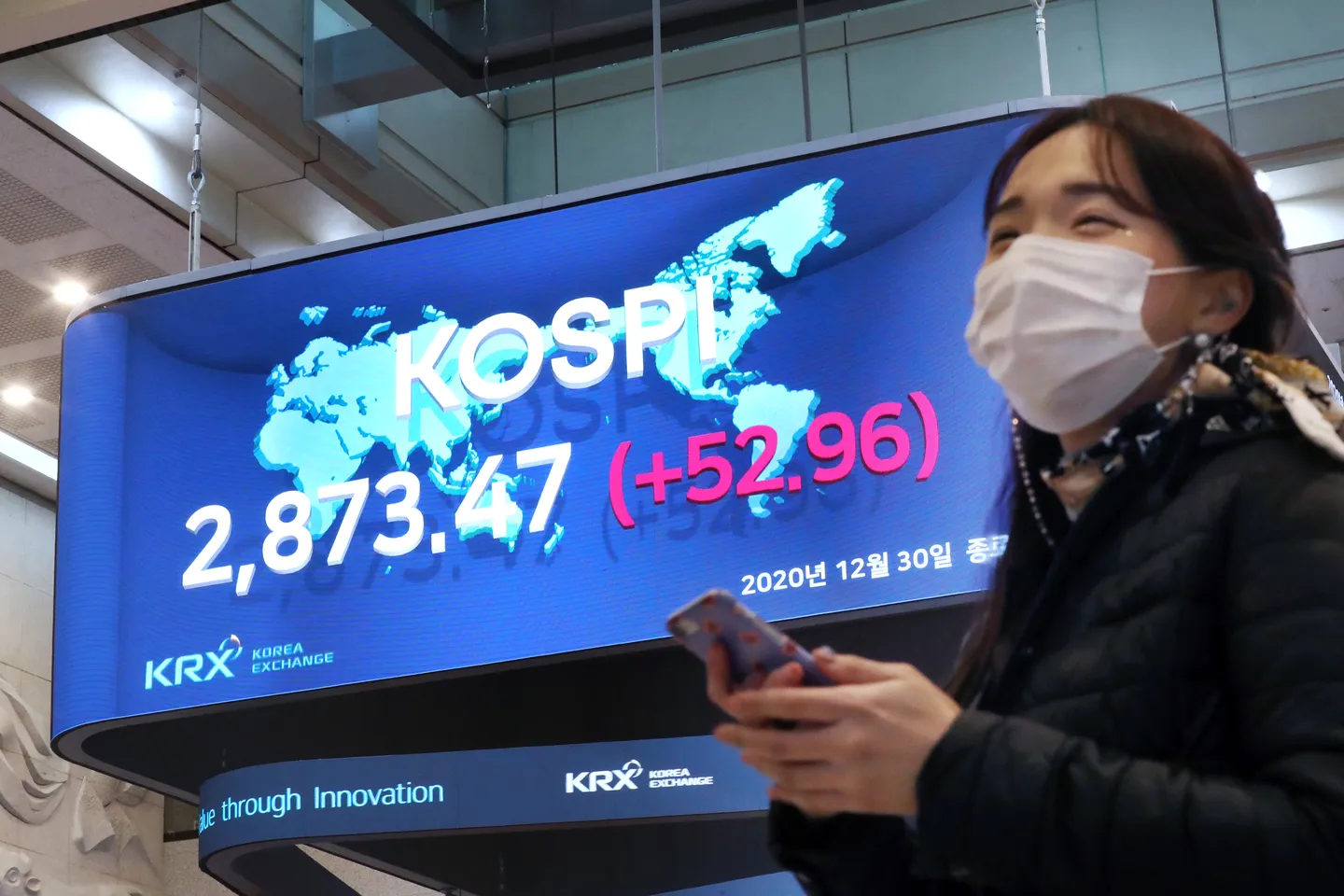
The Kospi hit what was then a record high in 2020, closing at 2,873.47 on the final trading day of the year on Dec. 30, 2025, supported by the buying spree of individual investors dubbed as the "Donghak Ant Movement" [NEWS1]
In a Gallup Korea survey released earlier this month, 37 percent of respondents named stocks as the most advantageous investment method, surpassing real estate at 22 percent. Since the survey began in 2000, real estate had consistently ranked No. 1 until July last year, when stocks overtook it for the first time. The gap has since continued to widen.
“The paradigm has already shifted,” Kim Yong-beom, presidential chief of staff for policy, wrote on Facebook on Jan. 31. “Stocks are gradually becoming the new default asset choice, not just a temporary trend.”
The surge in interest has also fueled a spate of sensational content that plays on investors’ anxieties.
On Sunday, a YouTube stock channel with about 50,000 subscribers uploaded a video titled “Buy right away on Feb. 23!! Three stocks set to skyrocket.” The operator claimed a previously recommended stock had already gained 20 percent and could jump 300 percent to 400 percent, urging viewers to join a Telegram group chat for exact buy and sell timing. In reality, one of the touted stocks fell 2.8 percent on the suggested day and slid another 6.2 percent the following day.
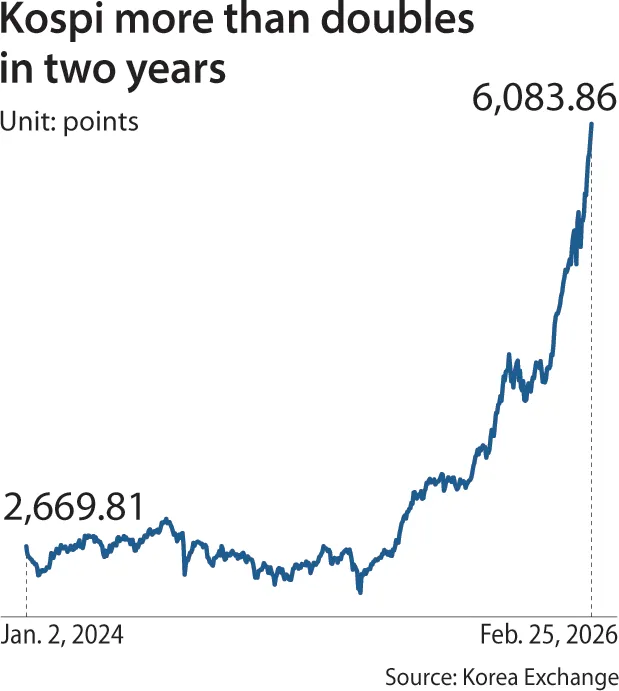
A graph shows the Kospi rising between Jan. 2, 2024 and Feb. 25, 2026. [KOREA EXCHANGE]
Misconduct has, in some cases, led to criminal punishment.
Kim Jeong-hwan, a YouTuber with over 500,000 subscribers and known as a "super ant," was found to have recommended five stocks he held between June 2021 and roughly one year later while secretly selling them for profit. The Supreme Court sentenced him to two years in prison, suspended for three years, along with a 300 million won fine.
“Securities firm reports are subject to internal controls, but YouTube channels lack verification systems,” an industry spokesperson warned. “There is a risk of manipulation, such as promoting stocks that the YouTuber has secretly bought.”
Another major concern is that financial literacy — the ability to understand and effectively use digital financial services and products, such as online banking and virtual assets — has failed to keep pace with the rapid rise in stock trading.
In a 2025 survey by the Korea Financial Consumers Protection Foundation, Koreans scored an average of 59.3 out of 100 in digital financial literacy — well below the OECD benchmark of 70. Lower scores indicate greater vulnerability to deceptive financial services and weaker decision-making ability. Respondents in their 50s recorded the highest average at 60.9, while those in their 20s posted the lowest at 54.2.
Experts caution that while “finfluencers” — a portmanteau of "finance" and "influencer" — can increase financial information access, blind trust poses a risk.
Visitors look around a special exhibition marking YouTube’s 15th anniversary during the “Google for Korea 2023” event hosted by Google Korea at the Shilla Hotel in Jung District, central Seoul, on Sept. 21, 2023. [YONHAP]
“Stocks that had positive reviews on YouTube channels have, in some cases, shown noticeable profit,” said Nam Gil-nam, a senior research fellow at the Korea Capital Market Institute. “However, as YouTube’s influence grows, individual decision-making could become distorted, potentially triggering market shocks driven by mob mentality.”
Stronger oversight is needed as stock investing becomes more mainstream, observers say. “The Financial Supervisory Service should continue monitoring finfluencers, establish clear rules for financial content on social media and strengthen investor education,” advised Ahn Yu-mi, senior researcher at the Korea Capital Market Institute.
“Young investors with limited capital are particularly vulnerable to misleading information, and the domestic stock market’s volatility leaves little room for recovery,” warned Hur Joon-young, an economics professor at Sogang University. “Structural reforms are needed to ensure stocks' position as a long-term asset.”
This article was originally written in Korean and translated by a bilingual reporter with the help of generative AI tools. It was then edited by a native English-speaking editor. All AI-assisted translations are reviewed and refined by our newsroom.
Reference Written by JANG SEO-YUN [lee.jiwon10@joongang.co.kr] Provided by Korea JoongAng Daily
※ Picks respects the rights of all copyright holders. If you do wish to make material edits, you will need to run them by the copyright holder for approval.
more from
KoreaJoongAngDaily
KoreaJoongAngDaily
Korea's traditional calligraphy and painting recast at national museum
2026-02-26 00:00:00
KoreaJoongAngDaily
Table for one: Korean workers choosing solo prepackaged takeout meals over team lunches
2026-02-25 00:00:00
KoreaJoongAngDaily
Korea's spring blossoms blooming earlier as temperatures rise
2026-02-24 00:00:00
KoreaJoongAngDaily
Heritage authorities find over 250,000 Korean cultural artifacts overseas
2026-02-22 00:00:00
BEST STORIES
The Conversation
Intermittent fasting doesn't have an edge for weight loss, but might still work for some
2026-02-24 00:00:00
Travie
Why February Is the Best Time to Visit Seattle: Museum Month Offers 50% Off Admission
2026-02-21 00:00:00
AllblancTV
Trending Moves to Melt Away Belly Fat (Part 2/2)
2026-02-23 00:00:00
Street Food Guy
The Grooming Rituals People Pack Before Big Trips
2026-02-21 00:00:00
Lifestyle
KoreaJoongAngDaily
'Gimflation' pushes firms to grow seaweed on land
2026-02-21 00:00:00
KoreaJoongAngDaily
Yi Sun-shin exhibition sets crowd record for National Museum of Korea
2026-02-20 00:00:00
KoreaJoongAngDaily
Digging for gold: Rising prices spark metal detecting boom on Korean beaches
2026-02-19 00:00:00
KoreaJoongAngDaily
Staying healthy this Seollal: Tips for eating right while keeping tradition