Your dog's dinner could be worse for the planet than your own - new research
by The Conversation
Cutting down the amount of meat we eat helps reduce greenhouse gas emissions associated with agriculture. But what about the meat that our pet dogs eat?
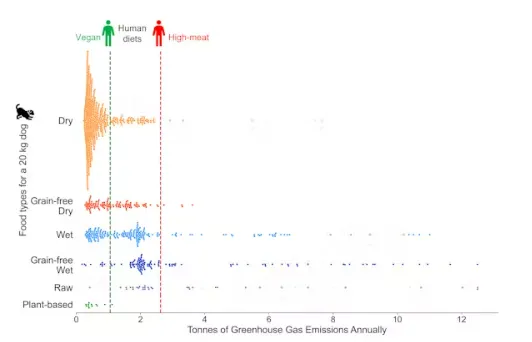
Our new study shows that feeding dogs can have a larger negative effect on the environment than the food their owners eat. For a collie or English springer spaniel-sized dog (weighing 20kg), 40% of tested dog foods have a higher climate impact than a human vegan diet, and 10% exceed emissions from a high-meat human diet.
Dog food comprises a significant part of the global food system. We have calculated that producing ingredients for dog food contributes around 0.9-1.3% of the UK’s total greenhouse gas emissions. Globally, producing enough food for all dogs could create emissions equivalent to 59-99% of those from burning jet fuel in commercial aviation.
The type of animal product used to produce pet food really matters. The environmental footprint of dog food differs for prime cuts and offal or trimmings.
Cuts like chicken breast or beef mince are used in some dog foods but are also commonly eaten by people. Selling these “prime cuts” provides around 93-98% of the money from selling an animal carcass.
By-products like offal and trimmings – which are less sought after for human consumption, much cheaper, but highly nutritious – are widely used in pet food. We assign more of an animal’s environmental footprint to high-value cuts and less to these by-products.
Greenhouse gas emissions for different types of dog foods: Diet-related greenhouse-gas emissions for a 20kg dog fed on diets (each shown by one point) of the different types we tested. We tested far more dry (kibble) foods than other types. For comparison, the emissions for a vegan and high meat human diet are shown.
Some previous studies have given by-products the same environmental impact by weight as the highest‑value cuts, directly using figures calculated for human food. This “double counts” livestock impacts and substantially overestimates the footprint of pet food.
A practical problem for pet owners and researchers like us is that it’s difficult to find out which parts of the carcass are in a product. Our study used mathematical models to estimate the composition based on the ingredients list and nutritional composition of each food.
Labelling guidelines allow broad terms such as “meat and animal derivatives”. These give manufacturers flexibility to change recipes but make it hard to distinguish between foods mainly based on low-value cuts and those rich in prime meat. Ingredients listed as chicken may be fresh, dehydrated (made from low value offcuts) or a mixture, and recipes are commercially sensitive.
For this reason, we adjusted our assumptions about nutrient content, environmental consequences of specific ingredients and the comparative values of meat products when estimating feed compositions. After repeating this process 1,000 times, one pattern was consistent: higher shares of prime meat drove up negative environmental effects.
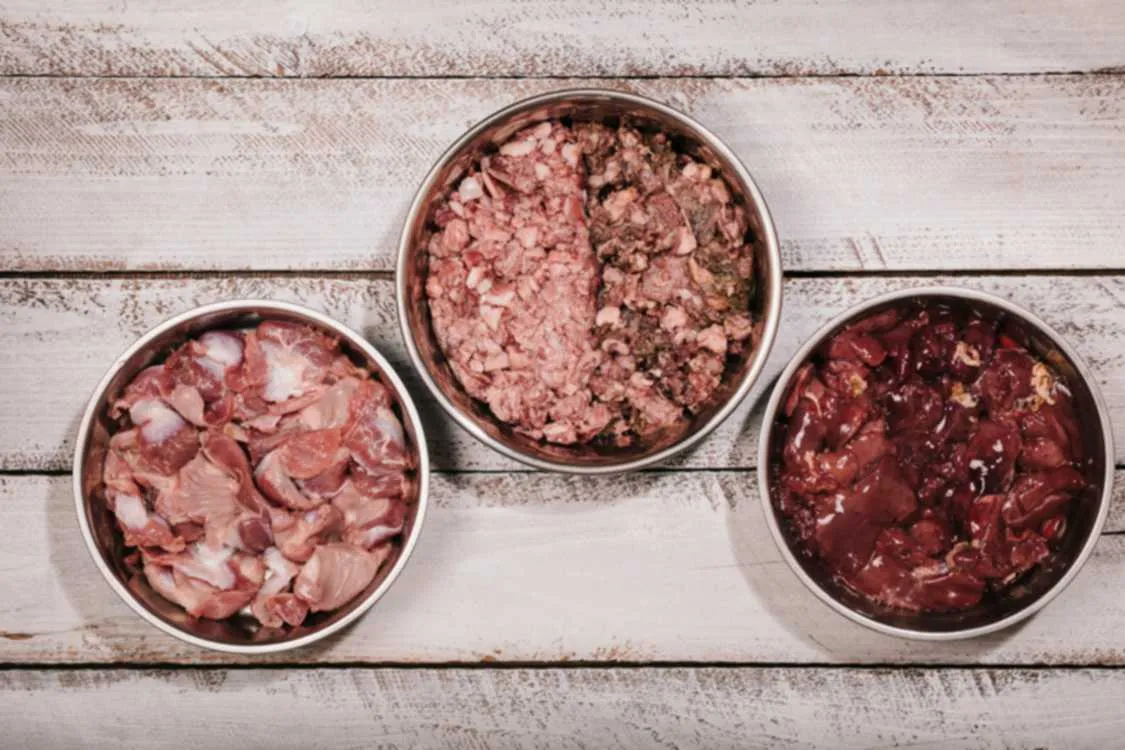
Higher shares of prime meat in dog food drives negative environmental impacts. Inna Vlasova/Shutterstock
Improved labelling – for example, indicating the proportion of prime meat v by‑products – would enable owners to make informed choices and allow better scrutiny of “sustainable” claims.
The format of pet food also matters. Some owners see raw and grain-free diets as more natural, although for many dogs these diets may offer no benefits and could introduce health risks, including nutritional imbalances and bacterial risks for dogs and their owners. Studies show that carefully formulated plant-based diets can meet dogs’ nutritional needs with similar health outcomes to meat containing diets, and there is increasing acceptance of this feeding approach from veterinary professionals.
On average, wet foods (for example, tinned or those packed in foil trays) and raw foods had more of a negative environmental effect than dry kibble. Grain-free options also have a greater environmental footprint than foods not marketed in this way. While the few plant-based diets we studied tend to be slightly less environmentally damaging than average meat-based ones, particularly among wet foods, this advantage is small compared to the difference between wet or raw and dry foods.
There are exceptions. For example, the lowest impact wet foods we studied had lower emissions than the typical dry food. And, the foods with the absolute lowest negative environmental consequences we tested included meat by-products.
Pet food choices can provoke strong emotions. One of us (John Harvey), a veterinary surgeon working on environmental sustainability, regularly sees owners torn between ideals of dogs as meat‑eating “wolves” and their wish to reduce environmental harm.
Our study shows that it’s not simply a matter of choosing between vegan diets and raw meat. Simple rules like “dry always has a lower environmental footprint than wet” do not hold for every product. The ingredient mix within each product is key.
So, for owners looking to reduce the environmental footprint of their pet food, it’s important to know that choosing grain-free, wet or raw foods can result in higher negative environmental effects compared to standard dry kibble foods. Regardless of food type chosen, selecting foods that use genuine animal by‑products or plant proteins rather than competing directly with meat humans typically eat is also preferable.
Dog foods showed over 65 times more variation in the effect they have on the planet, compared to a 2.5-fold difference between vegan and high-meat human diets. The potential to reduce – or increase – environmental damage by changing dog diets is enormous. By choosing meat products wisely for pet food and making labelling clearer, we can cut this hidden part of our food footprint and have healthy, well-fed dogs.
※ Picks respects the rights of all copyright holders. If you do wish to make material edits, you will need to run them by the copyright holder for approval.
more from
The Conversation
The Conversation
Greenland is rich in natural resources - a geologist explains why
2026-01-11 00:00:00
The Conversation
The US used to be really dirty - environmental cleanup laws have made a huge difference
2026-01-10 00:00:00
The Conversation
The western US is in a snow drought, and storms have been making it worse
2026-01-10 00:00:00
The Conversation
Viral outbreaks are always on the horizon - here are the viruses an infectious disease expert is watching in 2026
2026-01-10 00:00:00
BEST STORIES
KoreaJoongAngDaily
'Let's get gogi': How beef became Korea's celebratory meat
2026-01-10 00:00:00
The19th
'What does the new childhood vaccine schedule actually mean for your family?'
2026-01-08 00:00:00
Travie
A Beginner's Guide to Suzhou: Gardens, Canals, Museums, and Local Cuisine
2026-01-06 00:00:00
Fair Observer
YouTubing Reality The Kitten That Ate the House
2026-01-07 00:00:00
Lifestyle
The Conversation
Screens and social media are damaging kids' conversation skills. Here's why this matters, and how to get them back
2026-01-09 00:00:00
The Conversation
A fresh start feels powerful - until motivation fades. Here's how to set work goals that stick
2026-01-08 00:00:00
The Conversation
What are your new year's reading resolutions? 6 dedicated readers share theirs
2026-01-06 00:00:00
The Conversation
The 'pawprint economy' is booming- and it offers huge opportunities for tourism