Elusive wild cat feared extinct rediscovered in Thailand
by AFP
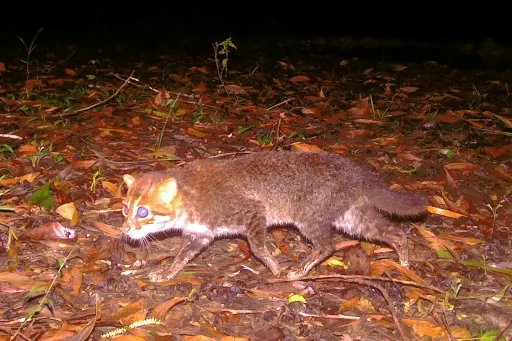
Flat-headed cats are among the world's rarest and most threatened wild felines
An elusive wild cat long feared extinct in Thailand has been rediscovered three decades after the last recorded sighting, conservation authorities and an NGO said Friday.
Flat-headed cats are among the world's rarest and most threatened wild felines. Their range is limited to Southeast Asia and they are endangered because of dwindling habitat.
The domestic cat-sized feline with its distinctive round and close-set eyes was last spotted in a documented sighting in Thailand in 1995.
But an ecological survey that began last year, using camera traps in southern Thailand's Princess Sirindhorn Wildlife Sanctuary, recorded 29 detections, according to the country's Department of National Parks, Wildlife and Plant Conservation and wild cat conservation organisation Panthera.
"The rediscovery is exciting, yet concerning at the same time," veterinarian and researcher Kaset Sutasha of Kasetsart University told AFP, noting that habitat fragmentation has left the species increasingly "isolated".
It was not immediately clear how many individuals the detections represent, as the species lacks distinctive markings so counting is tricky.
But the findings suggest a relatively high concentration of the species, Panthera conservation programme manager Rattapan Pattanarangsan told AFP.
The footage included a female flat-headed cat with her cub -- a rare and encouraging sign for a species that typically produces only one offspring at a time.
Nocturnal and elusive, the flat-headed cat typically lives in dense wetland ecosystems such as peat swamps and freshwater mangroves, environments that are extremely difficult for researchers to access, Rattapan said.
Globally, the International Union for Conservation of Nature estimates that around 2,500 adult flat-headed cats remain in the wild, classifying the species as endangered.
In Thailand, it has long been listed as "possibly extinct".
Thailand's peat swamp forests have been heavily fragmented, largely due to land conversion and agricultural expansion, said Kaset, who was not involved in the ecological survey but has researched wild cats for years.
The animals also face mounting threats from disease spread by domestic animals, and they struggle to reproduce across isolated areas.
While the rediscovery offers hope, it is only a "starting point" for future conservation efforts, he said.
"What comes after this is more important -- how to enable them to live alongside us sustainably, without being threatened."
※ Picks respects the rights of all copyright holders. If you do wish to make material edits, you will need to run them by the copyright holder for approval.
more from
AFP
AFP
Brazil megacity Sao Paulo struck by fresh water crisis
2025-12-26 00:00:00
AFP
'Starting anew' Indonesians in disaster-struck Sumatra hold Christmas mass
2025-12-25 08:03:00
AFP
'Southern California soaked by powerful Christmas storms'
2025-12-25 00:52:00
AFP
From predator to plate: Japan bear crisis sparks culinary craze
2025-12-24 00:48:00
BEST STORIES
AFP
'Southern California soaked by powerful Christmas storms'
2025-12-25 00:52:00
AllblancTV
Try THis Practical Lower-Body Routine to Burn Fat While on the Road
2025-12-25 00:00:00
Knowable Magazine
When clouds flock together
2025-12-21 00:00:00
Inven Global
2025 LCK Awards Announced for Dec. 19 as Gen.G, T1 Headline Korea’s Biggest Esports Night
2025-12-25 00:00:00
Environment
AFP
India space agency launches its heaviest satellite
2025-12-24 00:00:00
AFP
'Locals sound alarm as Bijagos Islands slowly swallowed by sea'
2025-12-23 00:22:00
AFP
'Immense' collection of dinosaur footprints found in Italy
2025-12-23 00:00:00
AFP
Sri Lanka cyclone caused $4.1 bn damage: World Bank
 Flat-headed cats are among the world's rarest and most threatened wild felines