'The North Pole keeps moving- here's how that affects Santa's holiday travel and yours'
by The Conversation
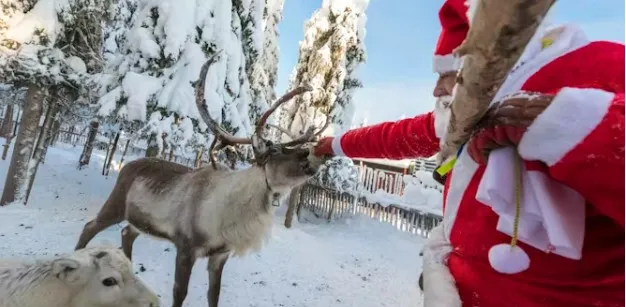
Could this be the next Blitzen? Feeding a reindeer in Lapland, Finland, north of the Arctic Circle. Roberto Moiola/Sysaworld/Moment via Getty Images
When Santa is done delivering presents on Christmas Eve, he must get back home to the North Pole, even if it’s snowing so hard that the reindeer can’t see the way.
He could use a compass, but then he has a challenge: He has to be able to find the right North Pole.
There are actually two North Poles – the geographic North Pole you see on maps and the magnetic North Pole that the compass relies on. They aren’t the same.
The two North Poles
The geographic North Pole, also called true north, is the point at one end of the Earth’s axis of rotation.
Try taking a tennis ball in your right hand, putting your thumb on the bottom and your middle finger on the top, and rotating the ball with the fingers of your left hand. The place where the thumb and middle finger of your right hand contact the tennis ball as it spins define the axis of rotation. The axis extends from the south pole to the north pole as it passes through the center of the ball.Compasses use a magnetized needle to align with Earth’s magnetic field. To find true north, a compass must be adjusted for the declination of its location, meaning the angle difference between true north and magnetic north for that spot. Tim Reckmann/Wikimedia Commons, CC BY Earth’s magnetic North Pole is different.
Over 1,000 years ago, explorers began using compasses, typically made with a floating cork or piece of wood with a magnetized needle in it, to find their way. The Earth has a magnetic field that acts like a giant magnet, and the compass needle aligns with it.
The magnetic North Pole is used by devices such as smartphones for navigation – and that pole moves around over time.
Why the magnetic north pole moves around
The movement of the magnetic North Pole is the result of the Earth having an active core. The inner core, starting about 3,200 miles below your feet, is solid and under such immense pressure that it cannot melt. But the outer core is molten, consisting of melted iron and nickel.
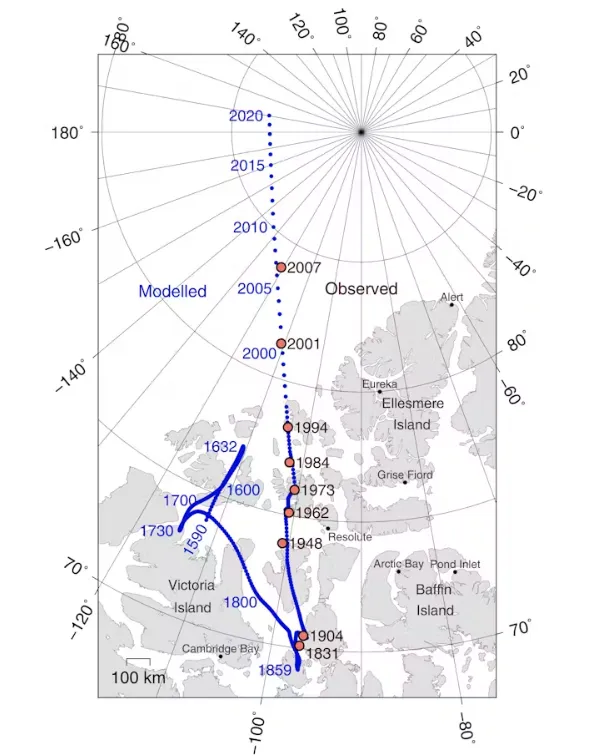
The magnetic North Pole has wandered since the late 1500s, picking up speed in the recent century. The dates reflect observations from expeditions. The others are based on models, with data from NOAA. The map shows northern Canada’s islands. The edge of Greenland is visible to the far right side. Cavit/Wikimedia Commons, CC BY
For most of the past 600 years, the pole has been wandering around over northern Canada. It was moving relatively slowly, around 6 to 9 miles per year, until around 1990, when its speed increased dramatically, up to 34 miles per year.
It started moving in the general direction of the geographic North Pole about a century ago. Earth scientists cannot say exactly why other than that it reflects a change in flow within the outer core.
Getting Santa home
So, if Santa’s home is the geographic North Pole – which, incidentally, is in the ice-covered middle of the Arctic Ocean – how does he correct his compass bearing if the two North Poles are in different locations?
No matter what device he might be using – compass or smartphone – both rely on magnetic north as a reference to determine the direction he needs to move.
While modern GPS systems can tell you precisely where you are as you make your way to grandma’s house, they cannot accurately tell which direction to go without your device knowing the direction of magnetic north.
Reference Written by Scott Brame Provided by The Conversation
※ Picks respects the rights of all copyright holders. If you do wish to make material edits, you will need to run them by the copyright holder for approval.
more from
The Conversation
The Conversation
Rising electricity prices and an aging grid challenge the nation as data centers demand more power
2025-12-22 00:00:00
The Conversation
'Where the wild things thrive: Finding and protecting nature’s climate change safe havens
2025-12-21 00:00:00
The Conversation
Slop, vibe coding and glazing: AI dominates 2025's words of the year
2025-12-20 00:00:00
The Conversation
The price of going home: Christmas boxes and the final return from South Africa to Zimbabwe
2025-12-20 00:00:00
BEST STORIES
AllblancTV
Daily Full Body Stretch While Sitting
2025-12-18 00:00:00
OpenMind Magazine
Are You a Climate Culprit?
2025-12-18 00:00:00
KoreaJoongAngDaily
A stocking full of shows: Christmas performances, musicals and concerts to check out in Seoul
2025-12-18 00:00:00
Inven Global
Tarantino’s Long-Lost Kill Bill Chapter Debuts Inside Fortnite at Hollywood Red Carpet Premiere
2025-12-19 00:00:00
Lifestyle
The Conversation
The surprising theology inside today’s Advent calendars
2025-12-19 00:00:00
The Conversation
Christmas trees are more expensive than ever in Colorado - what gives?
2025-12-17 00:00:00
The Conversation
Why you feel pressure to adhere to Christmas traditions - and how to reject the ones you don’t like
2025-12-17 00:00:00
The Conversation
Why do we wake up shortly before our alarm goes off? It’s not by chance
 Could this be the next Blitzen? Feeding a reindeer in Lapland, Finland, north of the Arctic Circle. Roberto Moiola/Sysaworld/Moment via Getty Images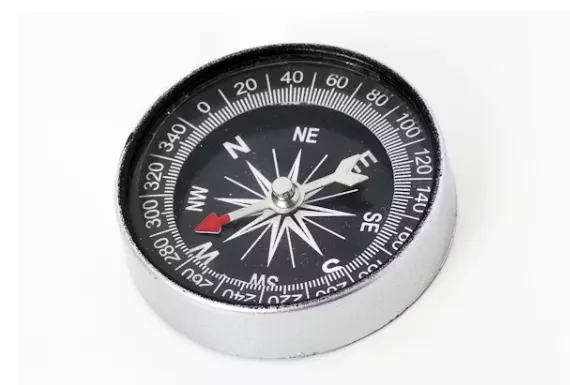
 Reference