Visa-free travel? Online hype? Why Korea's Gen Z is rushing to visit Shanghai.
by KoreaJoongAngDaily
Tourists take pictures in front of the Wukang Mansion in Shanghai, China [XINHUA NEWS AGENCY]
SHANGHAI — “Hanguo [Korea]?"
A restaurant worker asked the question in Mandarin to a small group of young women lingering at the storefront, their eyes darting between their phones and the signboard. When they nodded eagerly, she readily accessed her translation app and guided them through the online queuing system.
Though none of the young women spoke the language, 27-year-old Kim Min-hye said, “It’s been a pretty easy trip so far.” Kim was visiting Shanghai for three nights with two friends. “People have been very welcoming to Korean tourists at the places we’ve visited.”
Kim is part of a broader surge in travelers from Korea to China in the past year. A mix of policy changes and digital culture has propelled Shanghai to become one of Korea’s most talked about destinations, with social media recasting the city as a stylish, hypermodern playground for Gen Z young people and millennials.
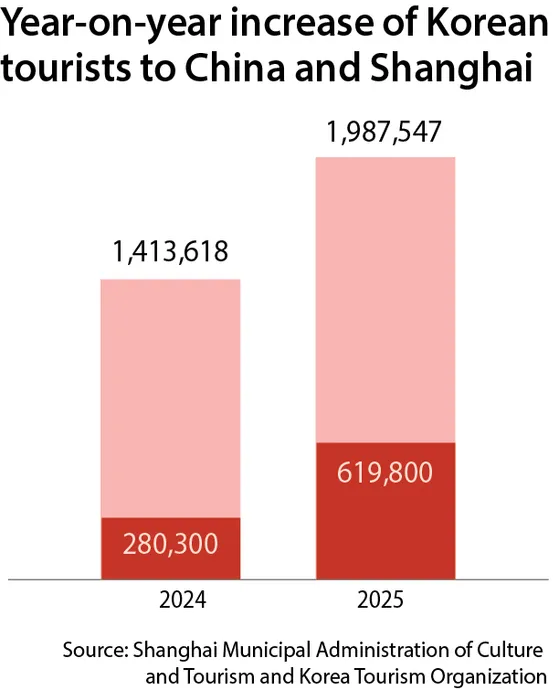
From January to August 2025, approximately 1.98 million Koreans visited China, a 40.6 percent increase from the same period last year, according to local news outlet Yonhap based on the Korea Tourism Organization's data. Shanghai, in particular, has seen explosive growth. It welcomed 619,800 Korean visitors between January and September, up 121.1 percent year-on-year, according to the Shanghai Municipal Administration of Culture and Tourism.
The growth follows China’s introduction of a 30-day visa-free entry policy for Koreans that began late last year. On Tuesday, China announced that it moved its foreign arrival cards fully online and extended the visa-free policy for another year. Combined with the fact that Shanghai is only an hour-and-a-half away, the city is currently one of the easiest foreign destinations for Koreans to visit.
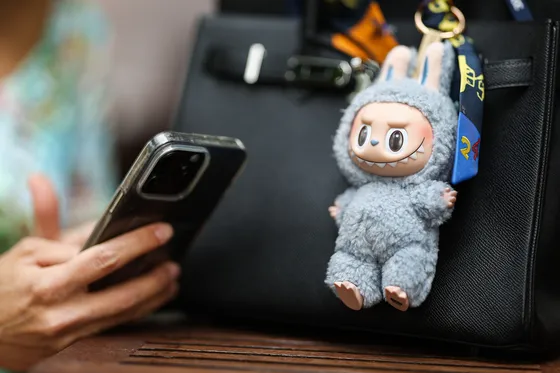
A Labubu key ring doll hangs on a handbag. [TASS]
Still, traveling within China has its unique challenges. Most services familiar to Korean travelers — KakaoTalk, WhatsApp, Google and YouTube — are blocked. Visitors also need to download Chinese apps with awkward English translations to hail taxis and use GPS maps. Credit cards and cash are rarely used, and payments are handled almost entirely through Alipay and WeChat Pay.
Yet, these hurdles have not deterred tech-savvy young travelers. If anything, Shanghai has emerged as one of the year’s most sought-after short-haul destinations for Korean millennials and Gen Z. On YouTube, more than 7,500 videos — many in the form of vlogs — are tagged “Shanghai travel,” while Instagram hosts over 171,000 posts under the same hashtag.
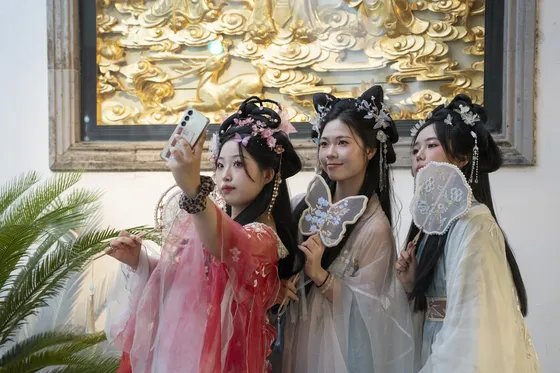
Tourists from Korea wearing hanfu (Chinese traditional dress) take a selfie at Yuyuan Garden Mall in Shanghai on July 21. [XINHUA NEWS AGENCY]
Social media feeds show fashionably dressed Koreans wandering among Shanghai’s towering skyscrapers, its wide boulevards lined with electric cars and the surprisingly lush trees that frame much of the city. Many film themselves cafe-hopping, posing under lit palaces, admiring the glittering skyline from the Bund and the Oriental Pearl Tower or indulging in themed meals at Shanghai Disneyland.
"Spin, spin!" a Chinese photographer shouted at two Korean females donning glittering hanfu (Chinese traditional dress), while visiting the historic Yu Garden at sunset.
“My perception of China has definitely shifted,” said Kim Sae-mee, 29, who is set to visit the city next week. From what she has seen on social media, she says, “It has become more positive, culturally interesting.”
A mukbang YouTuber eats a "towel cake" sold at China's bakery chain Holiland [SCREEN CAPTURE]
Food is another major draw.
If matcha has taken hold in the West, mala — the numbing, spicy Sichuan seasoning — has become Korea’s own viral flavor obsession over the past decade. Industry data reflects the trend. As of Nov. 11, China’s hot pot giant Haidilao is projected to surpass 100 billion won ($68 million) in annual sales in Korea this year, up from 78 billion won last year.
A more recent viral treat is the so-called towel cake, a pillowy roll cake made from thin, crepe-like layers wrapped around a cream filling so that it resembles a folded towel. Its fame in mukbang videos has made it a must-try item for young Korean visitors exploring Shanghai’s bakeries.
Blackpink’s Jennie drew global attention on the 2023 Cannes red carpet when she appeared in a minimalist black sleeveless gown by Shanghai-based brand Shushu/tong. [SCREEN CAPTURE]
Chinese fashion brands are also entering the spotlight for Korean consumers, and visiting their physical stores is a popular activity when visiting Shanghai. Many Koreans have discovered these brands through K-pop idols who have worn the labels in music videos or at major events. Blackpink’s Jennie drew global attention on the 2023 Cannes red carpet when she appeared in a minimalist black sleeveless gown from Shanghai-based brand Shushu/tong. The label has also been worn by K-pop group NewJeans, singer Olivia Rodrigo and actor Sydney Sweeney. Despite its rising profile, Shushu/tong does not yet operate a brick-and-mortar store in Korea.
Another brand gaining traction is Miniso. A general lifestyle goods store founded in Guangzhou in 2013, it entered the Korean market in 2016 and operated more than 70 locations. The franchise withdrew after five years amid criticism of being a “knockoff” of Korea’s dominant budget lifestyle chain Daiso. But Miniso reentered the country in December last year after reinventing itself as a character goods retailer featuring global intellectual property, such as Disney, Marvel, Harry Potter and Sanrio. The brand now operates three stores in Seoul and plans to open seven more nationwide.
Kim said she planned to stop by Pop Mart as well, the Chinese toy company best known for its randomly packaged collectible dolls, like the sensational Labubu.
“I plan to stop by if there is time. I’ve been to the store in Korea, but I'm curious if any products will be different in the Chinese stores,” she said. “I have a pretty packed itinerary, though.”
Tourists from Italy visit the Bund area in Shanghai on July 21.[XINHUA NEWS AGENCY]
Chinese contemporary culture isn’t just piquing the interest of Koreans.
According to data from China’s National Immigration Administration, a total of 333 million entries and exits were recorded at immigration checkpoints across China in the first half of 2025, up 15.8 percent from the same period last year. Among them, 13.64 million foreigners entered China visa-free, a sharp 53.9 percent year-on-year increase, accounting for 71.2 percent of all foreign arrivals.
A recent report by the World Travel and Tourism Council states that China is considered one of the most dynamic travel markets in the world. The tourism industry is projected to contribute 13.7 trillion yuan ($1.9 trillion) to the national economy in 2025 — the highest level on record.
A spokesperson for China’s foreign ministry Jin Lian was quoted earlier this year saying that China “appears increasingly cool.”
"China’s name-brand products have long been ignored abroad, often because they are considered inferior. That is starting to change,” an Economist article published earlier this month states. Though their products lack imaginative nuance, “Chinese creativity is making its way into mainstream Western consciousness.”
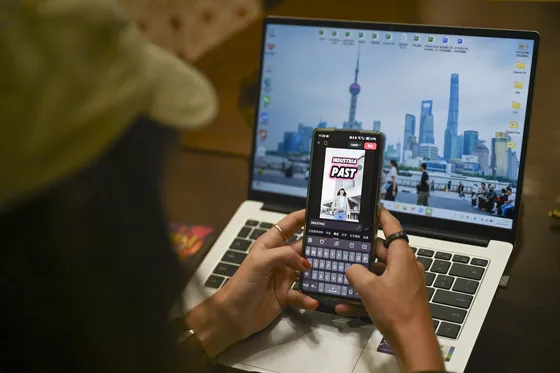
A social media influencer edits videos in her workshop in Shanghai, China, on Oct. 21. [XINHUA NEWS AGENCY]
Reference Written by LEE JIAN [lee.jian@joongang.co.kr] Provided by Korea JoongAng Daily
※ Picks respects the rights of all copyright holders. If you do wish to make material edits, you will need to run them by the copyright holder for approval.
more from
KoreaJoongAngDaily
KoreaJoongAngDaily
As K-pop dominates domestic scene, Korea's indie musicians look abroad to find audiences
2025-11-24 00:00:00
KoreaJoongAngDaily
School-age child flu rates 14 times higher this year as parents fret
2025-11-23 00:00:00
KoreaJoongAngDaily
Foreign students numbers rise, but few of them studying STEM
2025-11-22 00:00:00
KoreaJoongAngDaily
Former neighbors Joan Jonas and Nam June Paik 'reunite' at exhibition in Korea
2025-11-21 00:00:00
BEST STORIES
The Conversation
New study finds that ingesting even small amounts of plastic can be fatal for marine animals
2025-11-23 00:00:00
Travie
Unzen Onsen: Japan's Fiery Paradise for Relaxation and Reflection
2025-11-19 00:00:00
Science News
mRNA flu vaccines are making their way through clinical trials
2025-11-21 00:00:00
Fair Observer
How Indexed Insurance Could Build US Climate Resilience
2025-11-20 00:00:00
Lifestyle
KoreaJoongAngDaily
Seoul's historic Namdaemun Market to receive major facelift as competitiveness wanes
2025-11-18 00:00:00
KoreaJoongAngDaily
Regional cities find recipe for tourism success with food festivals
2025-11-17 00:00:00
KoreaJoongAngDaily
Jongmyo Shrine designated as World Heritage district
2025-11-15 00:00:00
KoreaJoongAngDaily
Exhibition showcases Korean artisans' unique traditional crafts in Washington