Fossil energy 'significant' driver of climate-fuelled heatwaves: study
by AFP
Updated: Sep 13, 2025, 11:31
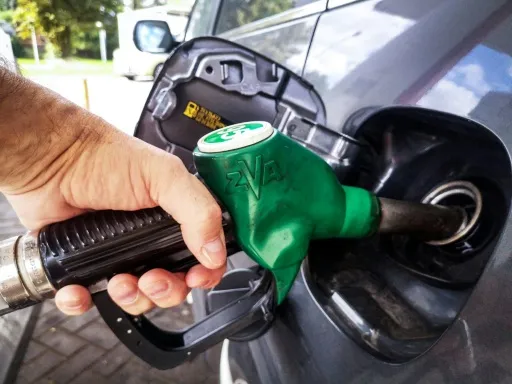
A man fills up his car at a gas station in Moscow on September 8, 2025
Fossil fuel and cement producers have contributed "significantly" to the growing number and intensity of climate-change-driven heatwaves, according to a study published on Wednesday in Nature.
An international team of scientists analysed more than 200 heatwaves around the world between 2000 and 2023 and found that climate change had made each of them more likely and more ferocious.
But they also took their attribution study one step further by teasing out the role of 180 major producers of polluting oil, gas, coal and cement.
They found emissions linked to these large companies contributed half of the increase in heatwave intensity compared to the pre-industrial era and also increased their probability.
The role of the 14 largest "carbon majors" -- including Saudi Aramco, Gazprom, Chevron and BP -- appears to be very significant, weighing as much as the 166 other companies studied.
The pollution from these firms has essentially been large enough to spark heatwaves, researchers said.
"Each producer alone can be enough to make heatwaves possible that would have been virtually impossible without climate change," said Yann Quilcaille of ETH Zurich, who led the study published in Nature.
Attribution studies generally measure the degree of influence of climate change on a particular extreme weather event.
To do this, scientists compare the current climate with a simulation of a climate that has not been warmed by human activities.
The latest study expanded the scope to a total of 213 heatwaves.
Researchers found that the influence of climate change had grown over time: it made heatwaves on average 20 times more likely between 2000 and 2009 and 200 times more likely from 2010 to 2019.
A quarter of the events studied (55 out of 213) were at least 10,000 times more likely. In other words, they would have been virtually impossible without global warming.
"We also show that emissions associated with the largest producers of fossil fuels and cement contribute significantly to heatwaves," Quilcaille told AFP.
Emissions from just one of these carbon majors would have been enough to cause events deemed 10,000 times more likely, they found.
- 'Leap forward' -
The authors took into account the entire value chain of the companies as well as the use of the products by customers. For example, they attributed to each oil group the emissions associated with the petrol it sold.
Pascal Yiou, from France's Laboratory for Climate and Environmental Sciences (LSCE), who was not involved in the study, told AFP it was "a summary of the current state of knowledge in heatwave attribution", playing down the effort to attribute the role of major polluters.
But Quilcaille said the study could aid corporate responsibility legal cases, which have not so far been able to draw on increasingly precise research linking carbon emissions with specific events.
In one, a Peruvian farmer sued German energy company RWE, accusing it of being indirectly responsible for the melting of a glacier near his home. In May, a German court rejected the case but recognised the principle of polluters' global responsibility for climate damage.
In a commentary published in Nature, Karsten Haustein, of the University of Leipzig, said the new research was a "leap forward" for climate litigation and diplomacy.
"It is another reminder that denial and anti-science rhetoric will not make climate liability go away, nor will it reduce the ever-increasing risk to life from heatwaves across our planet," said Haustein, who was not involved in the study.
※ Picks respects the rights of all copyright holders. If you do wish to make material edits, you will need to run them by the copyright holder for approval.
more from
AFP
AFP
Where AI lives: Southeast Asia's data centre boom
2026-02-26 02:49:00
AFP
DR Congo sanctuary resists bloody forest sell-off
2026-02-26 01:28:00
AFP
Snake-like robot unveiled for Fukushima debris removal
2026-02-26 00:00:00
AFP
'Ice melt threatens emperor penguins during annual moult: researchers'
2026-02-25 12:21:00
BEST STORIES
Weathernews
'El Nino Outlook: Winter Climate Patterns and Impacts on Flight Operations'
2026-09-15 00:00:00
Inven Global
'Torizon Telecom': A Classic-Style Shooter Built Entirely of Text
2026-09-19 00:00:00
AllblancTV
Try This Full Body Weight Loss Routine (Part 2/2)
2026-09-17 00:00:00
Street Food Guy
Can You Rent a Car at Antalya Airport Without a Credit Card?
2026-09-21 00:00:00
Environment
AFP
New Zealand mayor swims to allay sewage contamination fears
2026-02-25 02:45:00
AFP
Bali flooding prompts tourist evacuation: official
2026-02-24 13:13:00
AFP
US winter storm brings rare hush to snowy New York
2026-02-23 20:45:00
AFP
Italy's Enel to invest 20bn euros in renewables by 2028
 A man fills up his car at a gas station in Moscow on September 8, 2025